
Reading List on ‘Masculinities’
February, 2025
By Dr. Senel Wanniarachchi, a Postdoctoral Fellow at the University of Oxford’s School of Anthropology and Museum Ethnography. He is also a Visiting Fellow at the Department of Gender Studies of the London School of Economics and Political Science, where he completed his PhD. His research explores how discourses of “culture” and “heritage” appear in colonial archives and persist in contemporary contexts, including digital spaces. He is interested in how these narratives are used in frameworks that are anti-imperialist yet simultaneously ethnonationalist, patriarchal, and heteronormative. Senel co-founded Hashtag Generation, an activist organisation working at the intersection of human rights and technology.
In recent decades, there has been a growing interest in and talk about (especially online) on masculinity. On one hand, there is a nostalgic yearning by some for a time when “men could be men and women could be women” (though it’s never really clear when that time was). On the other hand, masculinity is understood to be a crucial factor in explaining various social phenomena: from the rise of fascist demagogues, a response to “feminists and queers going too far,” to sexual and gender-based violence being attributed to a “male loneliness epidemic” and the spread of “incel culture.” Within academic contexts, Men’s and Masculinity Studies is no longer considered a niche area of scholarly inquiry. In public culture and political discourse—ranging from pop psychology and podcasts by social media influencers to speeches made by political figures and opinion pieces by columnists—masculinity is a topic of widespread discussion.
At the invitation of Everystory Sri Lanka, I put together this reading list on the broad theme of masculinity. As with any attempt to condense a vast and evolving field that spans decades and vast geographies, it is imperfect and partial. However, I believe it offers a glimpse into a diverse range of works—ranging from historical, theoretical and empirical investigations to policy-oriented and journalistic accounts. There are some Sri Lanka-specific works and others from around the world. The readings are grouped thematically, allowing you, the reader, to choose which ones resonate with you and engage with them at your own pace.
Let’s get started!
In her groundbreaking work, Masculinities (1995), Australian sociologist Raewyn Connell challenges the dominant assumption that there is a singular kind of masculinity. Instead, Connell proposes that there are multiple masculinities, each shaped by specific power relations, historical lineages, and sociocultural contexts. A key concept she introduces here is “hegemonic masculinity”, the dominant form of masculinity that enforces social inequalities—especially gender, class, and racial hierarchies. This hegemonic “ideal type” of masculinity is often constructed in opposition to femininity and marginalized forms of masculinity. Though Connell's work is from the 1990s, it has been profoundly influential and remains relevant today. While the entire book is insightful (though long), the introduction (pages xi-xxiv on the hyperlink above) offers a clear and accessible overview of the full work, making it a great starting point for us.
Then there is a range of important interventions which show us how historical (and ongoing) socio-political processes such as colonialism, anticolonialism, the formation of nation-states and postcolonial nationalism are shaped by and through masculinity. For example, in relation to the Bengali context, in the book Colonial Masculinity, Historian Mrinalini Sinha has described how the coloniser/colonised divide among elite men was constituted as the “manly Englishman” and the “effeminate Bengali babu” in nineteenth-century India (I recommend reading the Introduction chapter). In my own research into the Sri Lankan context, I have discussed how the Sinhalese custom of wearing a comb in the hair was seen by the colonial British administration in Ceylon as a sign of effeminacy and of Sinhalese men being improperly gendered, and therefore civilisationally inferior. Within this context, British colonialism was framed as a civilising mission to (amongst other things) teach backwards colonised people “how to do gender right”.
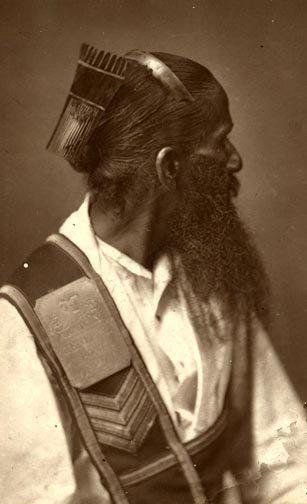
A Post Office Mail Carrier in 1890's in all his pomp & pageantry
Source: The Archives Sri Lanka
In the essay "Mama's baby, papa's maybe" literary critic Hortense Spillers (1987) shows how Black people's gender and family structures were distorted by slavery, creating a legacy where Black masculinity is often uncertain or "maybe" because Black men were not treated as men (or human) but as property, thus destabilizing traditional fatherhood and manhood. Similarly, within this context, the category of femininity was only available to white women with black women being reduced to mere reproductive vessels, valued primarily in relation to their ability to bear children for the slave economy.
It is important to note that the categories of masculinity and femininity as we understand them today were (and continue to be) shaped by race. If the ways we view masculinity (and indeed femininity) were profoundly influenced by developments such as European colonialism and transatlantic slavery, they were also shaped by anticolonial movements and postcolonial nationalism. For example, Indian political scientist Partha Chatterjee’s Colonialism, Nationalism, and Colonialized Women: The Contest in India (1989) discusses how “the nationalist resolution against the dominance of colonialism was built around a separation of the domain of culture into two spheres”—the material and spiritual The material (masculine) domain, which carried the responsibilities of maintaining Western codes of constitutionalism and governance, was assigned to men, while the private, or feminine, domain, predominantly entrusted with reproducing the nation biologically, culturally and symbolically, was assigned to women.
As the late historian Janaki Jayawardena has pointed out in her doctoral thesis, Cultural Construction of the 'Sinhala Woman' and Women's Lives in Post-Independence Sri Lanka, Sinhalese nationalist leaders imagined the identity of the postcolonial state as a “Sinhala Buddhist State”; however, “within this state, the roles and places for men and women were clearly demarcated” (2002). She argues that ideas around inheritance, “the breadwinner”, the head of the family and different dress codes were profoundly shaped by colonialism. Jayawardena goes on to show how nationalists further established and maintained these ideas in the name of “Sinhala Buddhist culture”.The Conclusion chapter of the thesis offers a useful summary of her main claims (pages 318 - 333).
Let us consider a different, more policy-oriented text: the report Broadening Gender: Why Masculinities Matter, co-authored by academics Neloufer de Mel and Pradeep Peiris and feminist activist Shyamala Gomez. The study is based on a survey of 1,658 men and 653 women between the ages of 18–49 years from Colombo, Hambantota, Batticaloa and Nuwara Eliya Districts. The study revealed some alarming findings. For instance, 36% of all partnered men surveyed reported perpetrating physical and/or sexual violence against an intimate partner. In terms of attitudes, while 74% of men disagreed with the statement that “there are times when a woman deserves to be beaten,” a majority of men (64%) subscribed to the view that childcare is primarily a mother’s responsibility. The study also found that in some cases, women hold more inequitable attitudes than men. For example, 67% of women (and 55% of men) affirmed that “in any rape case, one would have to question whether the victim/survivor is promiscuous or has a bad reputation,” and 75% of women (and 79% of men) reported that “some women ask to be raped by the way they dress and behave.” These findings are a reminder that patriarchal and even misogynist attitudes are shared across all genders. This study, supported by Care Sri Lanka, has been profoundly influential across civil society, policy and academic contexts. How might these figures have evolved since then? What may have changed, and what might have remained the same? The study’s Executive Summary (pages 3–5) offers a good overview of its main findings.
Ideas about how to be a man and how to be a woman are upheld socially, and people experience a great amount of social pressure to conform. Those trespassing these dictates are often socially, and sometimes even legally, sanctioned. For example, a range of Sri Lankan anthropologists have considered how lajja-baya (shame-fear) operates within Sinhalese society (and in Sri Lankan society broadly). In the piece A Space for Violence: The Location of a Sinhala Practice of Masculinity, Pradeep Jeganathan, drawing from the work of Gananath Obeyesekere, sheds light on phrases such as “lajja nathdha” (aren’t you ashamed?) or “minissu monawa kiyaida?” (what will other people say?), which parents deploy to normalise certain behaviours and to mark others as unacceptable. Within this context, he shows how fearlessness, or baya-nathi (kama), is an important practice of Sinhala masculinity.
While we engage with these texts, it is important to remember that binary divisions such as sex/gender, man/woman, hetero/homosexual and masculine/feminine are themselves human constructions, and we must not accept them unproblematically. For instance, in the piece We Are All Nonbinary: A Brief History of Accidents, Kadji Amin shows how the gender binary has always been unstable, shaped by historical “accidents” in science, philosophy, and bureaucracy that inadvertently opened space for nonbinary possibilities. Amin critiques universalising narratives and instead demonstrates how nonbinariness emerges from specific, uneven cultural and institutional conditions. Similarly, within the Sri Lankan context, in the piece Butching It Up: An Analysis of Same-Sex Female Masculinity in Sri Lanka, Jayanthi Kuru-Utumpalaa explores the experiences of twelve gender non-conforming lesbians. She draws from Western feminist and queer theories while critiquing their applicability to non-Western contexts, showing how these women embody a form of female masculinity.
To return to the “crisis of masculinity” I referred to at the start of the piece, in “What Did Men Do to Deserve This?”, Jessica Winter critically examines this growing discourse, often framed as a result of economic and cultural shifts. Winter challenges the narrative that men are uniquely suffering from these changes. She argues that many of the issues discussed, such as economic insecurity and shifting gender roles, are structural and affect all genders, yet the focus on male struggles often ignores the broader social forces at play. For example, she discusses a statistic that is often cherry-picked within some political commentary: that women are attending college more than men in the United States today. However, she points out that while this is true, research also shows that women need more education to earn the same amount of money as men. Winter urges a reimagining of masculinity that moves beyond nostalgic ideals and offers healthier, more inclusive models of identity, drawing attention to how these masculinities are entwined with societal expectations and inequalities.
This is not to suggest that men do not experience gendered forms of exclusion, especially when coupled with other forms of marginalisation. For instance, the article “Men, Masculinity, and Migration” explores the stereotype of the male migrant as one of the most maligned groups in the contemporary West. Even in pro-migrant discourses, empathy is often disproportionately directed toward women and children, while male migrants—particularly Black and Brown men—are frequently overlooked or negatively stereotyped. This piece highlights how male migrants, despite facing similar hardships, are excluded from the broader narrative of empathy and human rights. Similarly, in the article “Our Boys & Men Deserve to Live, Not Just Our Women & Children”, Ayesha Khan argues that Black, Brown, Arab and Palestinian boys and men deserve recognition, and respect in life—not just when they are framed as victims or martyrs. By calling for equal acknowledgment of men’s lives in both life and death, this piece critiques the gendered and racialized ways in which empathy is allocated.
In relation to the internet, and capitalism, in Anti-feminism as anti-establishment and emancipatory: the gendered metapolitics of Incel Henry Price explores the Incel phenomenon, which has become a frequently cited example of extreme contemporary misogyny and antifeminism. Price highlights how Incels interpret the neoliberal world as necessarily pro-feminist, collapsing all distinctions between women, feminists, and elite power. The piece offers a more nuanced understanding of Incels, demonstrating how antifeminism and misogyny are structured within this culture and how it connects, in complex ways, to far-right politics.
And finally, I wanted to end with a personal favourite. In the piece Masculinity as cruel optimism Jonathan Allan argues that one can never be masculine enough. “We always seem to fail at masculinity”. We are told to ‘man up’ and yet the very command does not explain the conditions by which one can ‘man up.’ Masculinity is a kind of cruel optimism insofar as we continue to believe in its possibility, and that this cruel optimism is caught amongst ‘shame,’ ‘fear,’ and ‘dread.’
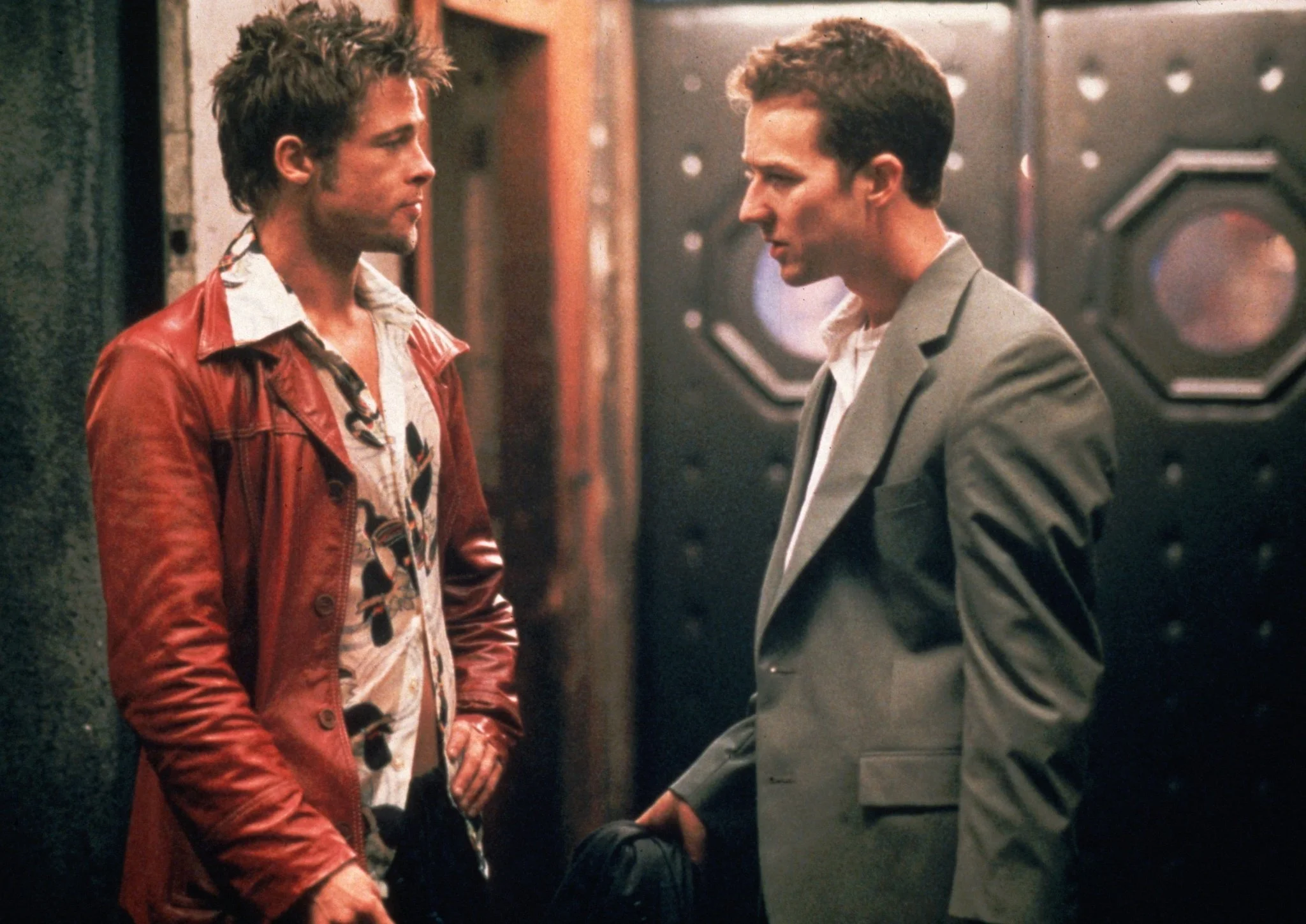
Fight Club (1999) - IMDb
These themes have been explored in films such as Fight Club, which examines masculinity in relation to consumerism and the search for identity, and Manchester by the Sea, which portrays grief and emotional repression. The 2016 Moonlight interrogates Black masculinity and the (im)possibility of queer desire while the Bollywood film Animal, starring Ranbir Kapoor, presents what many would describe as toxic masculinity. In contrast, the Malayalam film Kumbalangi Nights explores masculinities that challenge patriarchal stereotypes while the Sinhala film Machan explores masculinities in the context of economic hardships and migration in the search of ‘the good life’ in the West.
To conclude, in this piece I have put together a series of readings and other material that I have learned much from, and I hope you will too. What have you read about masculinity recently? What have I missed? Please share any suggestions in the comments section. While I believe these are all informative readings, I encourage you to engage with them critically: reflect on how you can expand their scope, and consider what works and what doesn’t. This is especially important for readings from or about Western contexts, which may not be wholly applicable to Sri Lanka.
Wherever possible, I have tried to find open-access copies of the works I recommend. Due to inequalities in knowledge production and dissemination, this hasn’t always been possible. Please feel free to get in touch with me via email if you would like me to share any PDF copies of the works listed here—I would be more than happy to do so.
Happy reading!
Bibliography
Books, Articles, Theses, and Web Sources
Connell, Raewyn. Masculinities. Berkeley: University of California Press, 1995.
Sinha, Mrinalini. Colonial Masculinity: The ‘Manly Englishman’ and the ‘Effeminate Bengali’ in the Nineteenth Century. Manchester: Manchester University Press, 1995.
Spillers, Hortense. “Mama’s Baby, Papa’s Maybe: An American Grammar Book.” Diacritics 17, no. 2 (1987): 64–81.
Chatterjee, Partha. 1989. “Colonialism, Nationalism, and Colonialized Women: The Contest in India.” American Ethnologist 16 (4): 622–633. Wiley on behalf of the American Anthropological Association.
Jayawardena, Janaki. Cultural Construction of the 'Sinhala Woman' and Women's Lives in Post-Independence Sri Lanka. PhD diss., University of London, 2002.
de Mel, Neloufer, Pradeep Peiris, and Shyamala Gomez. Broadening Gender: Why Masculinities Matter. Colombo: CARE Sri Lanka, 2009.
Jeganathan, Pradeep. “A Space for Violence: Anthropology, Politics and the Location of a Sinhala Practice of Masculinity.” Subaltern Studies 11 (2001): 37–65.
Amin, Kadji. “We Are All Nonbinary: A Brief History of Accidents.” Journal of Gender Studies 35, no. 4 (2022): 512–534.
Kuru-Utumpalaa, Jayanthi. 2013. “Butching It Up: An Analysis of Same-Sex Female Masculinity in Sri Lanka.” Culture, Health & Sexuality.
Winter, Jessica. 2025. “What Did Men Do to Deserve This?” The New Yorker, November 9, 2025. https://www.newyorker.com/culture/the-weekend-essay/what-did-men-do-to-deserve-this.
Price, Henry. 2024. “Anti-Feminism as Anti-Establishment and Emancipatory: The Gendered Metapolitics of Incel.” Feminist Media Studies 24, no. 5: 1042–1058.
Wanniarachchi, Senel. 2024. A History and Theory of Colonial Loot: An Exploration into “Sri Lankan” Artefacts in British Museums. PhD thesis, London School of Economics and Political Science.
Migrants’ Rights Network. 2024. “Men, Masculinity and Migration.” Migrants’ Rights Network, January 24, 2024. https://migrantsrights.org.uk/2024/01/24/men-masculinity-migration/.
Khan, Ayesha. 2023. “Our Boys & Men Deserve to Live, Not Just Our Women & Children.” The Woke Scientist (Substack), November 2023. https://wokescientist.substack.com/p/our-boys-and-men-deserve-to-live. (ir-women.com)
Sinha, Mrinalini. “The Colonial Stereotype of the Effeminate Bengali Man Was All About Power.” Video, 2023. Facebook. https://web.facebook.com/theswaddleindia/videos/the-colonial-stereotype-of-the-effeminate-bengali-man-was-all-about-power-dr-mri/879839776126922/.
Films
Fight Club. Directed by David Fincher. 20th Century Fox, 1999.
Manchester by the Sea. Directed by Kenneth Lonergan. 2016.
Moonlight. Directed by Barry Jenkins. A24, 2016.
Animal. Directed by Sandeep Reddy Vanga. Dharma Productions, 2023.
Kumbalangi Nights. Directed by Madhu C. Narayanan. Four Frames, 2019.
Machan. Directed by Uberto Pasolini. IFC Films, 2008.
Dr. Senel Wanniarachchi is a Postdoctoral Fellow at the University of Oxford’s School of Anthropology and Museum Ethnography. He is also a Visiting Fellow at the Department of Gender Studies of the London School of Economics and Political Science, where he completed his PhD. His research explores how discourses of “culture” and “heritage” appear in colonial archives and persist in contemporary contexts, including digital spaces. He is interested in how these narratives are used in frameworks that are anti-imperialist yet simultaneously ethnonationalist, patriarchal, and heteronormative. Senel co-founded Hashtag Generation, an activist organisation working at the intersection of human rights and technology.