
Reading List on The Participation and Representation of Women in Electoral Politics
January 2022Curated by Dr. Chulani Kodikara who has just completed her Ph.D. at the University of Edinburgh. Her thesis is titled ‘Inscriptions and Erasures, Grief, Hope, and Rights: A struggle for truth and justice for disappearances in postwar Sri Lanka’. She was previously a researcher with the Consultation Task Force on Reconciliation Mechanisms. Dr. Chulani Kodikara’s bio can be found after the reading list.
A good place to begin the study of women’s representation and engagement with politics is with the concept of democracy and its relationship to the idea of political representation. Feminism from the very outset has had an interest in critiquing, expanding, and revitalizing democratic theory and practice on the ground that democracy has not served women well and that citizenship in all democratic traditions — whether in the civic republican, liberal, or the social democratic traditions — is characterized by women’s exclusion.
Carol Pateman’s Sexual Contract (1988) has provided much of the groundwork for feminist critiques of the notion of the universal citizen; the public and private divide that excludes women from the public sphere, including democratic institutions, as well as the concept of formal equality. Also check out her Disorder of Women: Democracy, Feminism, and Political Theory (1989), which brings together a selection of essays that engage with democratic theory.
Can Democracy Work for Women (n.d.) by Suzanne Dovi is a short and accessible article, which discusses how feminist theorists have helped us understand the question, “what would it mean for women to be adequately represented in a democracy?” In this article she also discusses different models of democracy and feminist contributions to the democratic theory under 4 themes: 1) understanding of what needs to be represented; 2) the formal as well as informal barriers to the representation of women; 3) functions that representatives perform, and 4) dangers of democratic norms that justify representative institutions.
You can also read Anne Philips ‘Must Feminists Give Up on Liberal Democracy’ (1992) for a discussion of feminist critiques of democracy under the three headings of citizenship, participation, and heterogeneity.
For a recent update of many of these critiques taking as a starting point Colin Crouch’s concept of post-democracy, see Gundula Ludwig’s ‘Post Democracy and Gender: New Paradoxes and Old Tensions’ (2018). Engaging with Crouch’s critique that democracies have been reduced to a façade, where politics is increasingly shaped by political actors who lack any democratic legitimization, Ludwig aims to reveal the gendered impacts of post-democracy. She argues that from a feminist perspective, democracy was highly exclusive along three dimensions — the construction of the 1) political subject; 2) the demos and 3) the political. Moreover, she highlights that post-democracy prolongs gendered exclusions and reconfigures the relationship between the political and the social. This is a fascinating discussion about what is considered properly political in modern democracies.
Women in Politics in Sri Lanka
Sri Lanka provides a really interesting laboratory to test these insights about democracy because of the early achievement of the franchise, the favorable human development indicators for women, and two women occupying the highest level of government.
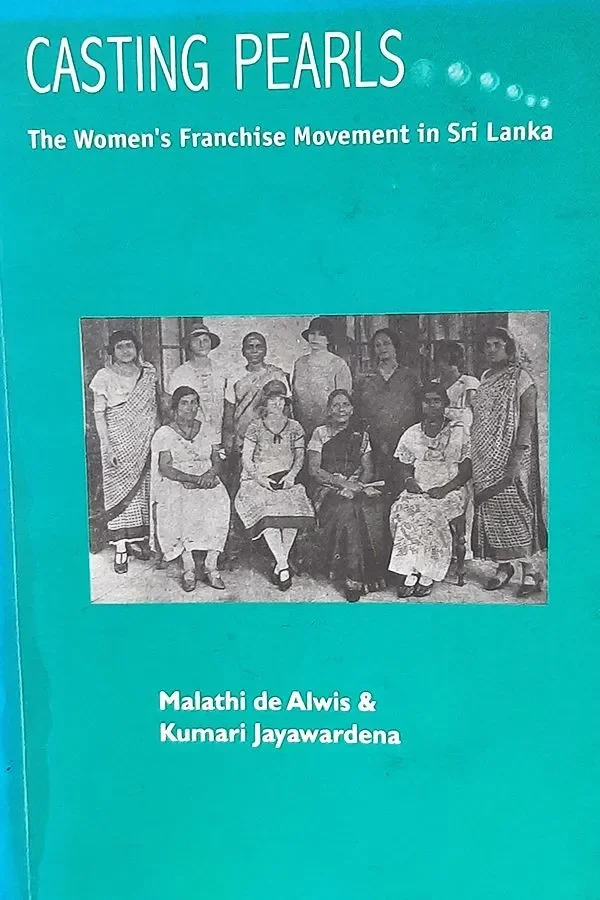
Malathi de Alwis and Kumari Jayawardena’s history of the Women’s Franchise Union and their struggle for universal adult franchise documented in Casting Pearls: The Women’s Franchise Union in Sri Lanka (2001) is a good place to start any study of women and politics in Sri Lanka. This book includes a fascinating discussion of the discourses of political leaders who opposed the franchise for women as well as media reports on the issue. Elsewhere, De Alwis also shows that norms around domesticity and respectability that inspired the opposition to women getting the vote in 1931, have persisted to this day, shaping our perceptions of and attitudes towards women in politics.
See for instance ‘Gender, Politics and the Respectable Lady’ (1995) for an exploration of the discourses and practices that make and unmake respectability in politics with a focus on Sirimavo Bandaranaike and Hema Premadasa.
There is now extensive literature on women’s participation in formal politics in Sri Lanka in the years after obtaining universal franchise: The work of scholars such as Wimala de Silva, Sirima Kiribamuna, and Kamala Liyanage provide a rich tapestry of women’s participation in political party activities such as organizing, campaigning, and fundraising in the post-independence period. There is also a spate of articles that have analyzed the continuing underrepresentation of women in political institutions in the midst of significant social change including the civil war, changes made to the electoral system, and the shift to a neoliberal economy. See for instance Wickramasinghe and Kodikara’s ‘Representation in Politics: Women and Gender in the Sri Lankan Republic’ (2012), which analyses the issue of women in politics from the angles of numerical representation, policy discourses, substantive gains, ideological perceptions, and socio-political practices. For a discussion of Tamil women’s participation in parliamentary and party politics read Ambika Satkunanathan’s in ‘Whose Nation? Power, Agency, Gender and Tamil Nationalism’.
Within the literature on political participation in Sri Lanka, the local government has received a fair share of attention. Recent writing on this issue includes Kamala Liyanage’s ‘Women in Local Self Governance in Sri Lanka: Problems, Dilemmas and Challenges’ (2005) and ‘Testing the Politics of Presence: Women’s Representation in Local Government in Sri Lanka’ (2018); Sarala Emmanuel’s ‘Making Ripples in Public Political Space: The Entry of Women into Local Government in Post War Batticaloa’ (2018); and ‘From Associational to Electoral Politics: A continuation of the land rights struggle in Paanama’ (2018) by Buddhima Padmasiri and Samanthi Gunawardana. See also Don’t Think of Me as a Woman: An Election Story from the Margins (2014), a film by Dr. Chulani Kodikara and Jeyachitra Velayudan which traces the attempt by Aynoon Beebi, a 39 year old Muslim woman from Kinniya, Trincomalee to enter local government at the 2011 local government elections.
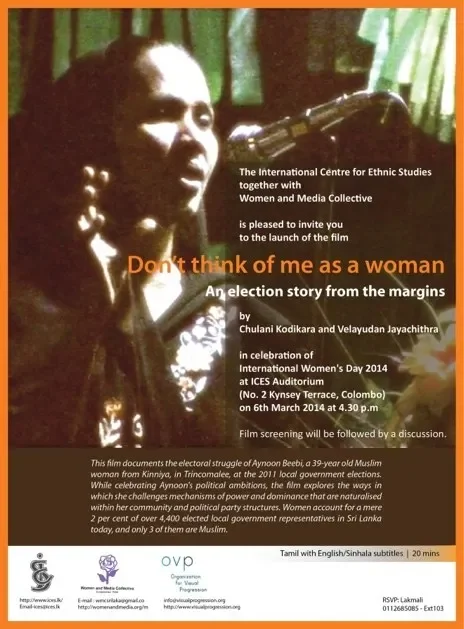
Obstacles to Women’s Equal Participation and Representation in Politics.
The discussion on the obstacles to equal representation of women in politics has tended to focus on a range of factors such as gender norms, cost of elections, violence, and lack of support from political parties as one of the biggest obstacles to equal representation of women in formal politics
Indeed, a number of recent research studies have greatly added to our understanding of political parties in Sri Lanka. While they do not explicitly incorporate gender into their analysis, Pradeep Peiris’ ‘Changing Dynamics of the Party-Voter Nexus’ (2018) and Catch-All Parties and Party-Voter Nexus in Sri Lanka (2021) as well as Jayadeva Uyangoda’s ‘Political Parties in Crisis or Transition?’ (2018) give us a glimpse into parties as deeply gendered regimes. Indeed, the findings of these studies, suggest that parties have become more masculinized, informal, and difficult to navigate for women over the last decade or so in Sri Lanka.
For a feminist analysis of the role of political parties in constructing and perpetuating the gender division of labor within the sphere of politics, see Tania Verge’s ‘The Gender Regime of Political Parties: Feedback Effect between “Supply” and “Demand”’ (2015) and Elin Bjarnegård and Meryl Kenny’s ‘Revealing the “Secret Garden”: The Informal Dimension of Political Recruitment’ (2015).
The Struggle for a Quota for Women in Sri Lanka
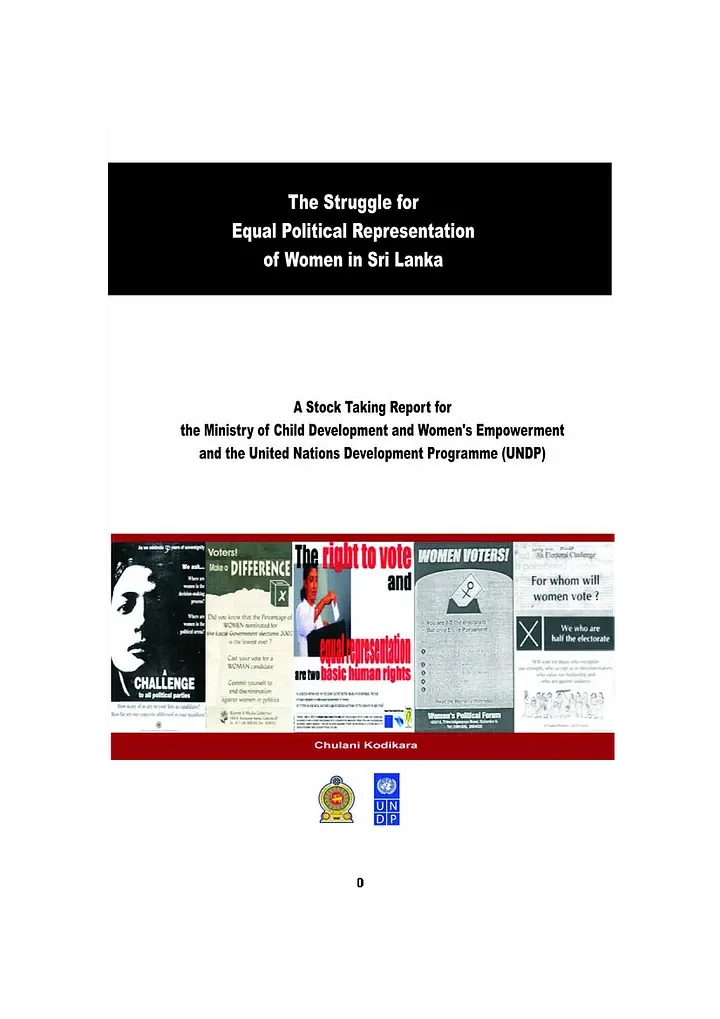
Women’s organizations in Sri Lanka, from the late 1990s onward, tried many tactics and strategies to address the under-representation of women in politics. These included training of women for political leadership to putting forward independent women’s lists. I document these efforts in a chapter in The Struggle for Equal Political Representation of Women(2009). Ultimately, however, there was a realization that the only way to address the historical marginalization of women from formal politics and challenge patriarchal cultural norms and practices underpinning this under-representation both within and outside political parties was through a mandatory quota for women. Based on this realization women’s organizations mobilized to demand a quota in local government from around early 2000. For a brief history of this struggle, see Sharni Jayawardena’s documentary film — Choosing Politics (2021).
The significance of the 25% quota for women introduced in 2016/2017 cannot be overemphasized. For a discussion of the 2016 local government quota law see Ramona Vijeyarasa’s ‘Women’s Absence in Sri Lankan Politics: Lessons on the effectiveness and limitations of quotas to address under-representation’ (2020). Following the 2018 elections, a total of 1919 women were elected to local government, paving the way for many women with no prior experience in politics and no connection to political families to enter local government. The issue of quotas for women in politics remains controversial in Sri Lanka, despite their long history across the globe. For theoretical arguments in favor of, implications of the design of quotas, and debates around quotas see the work of Ann Philips’s ‘Dealing With Difference: A Politics of Ideas Or A Politics of Presence?’ (1994), Andrea Cornwall and Anne Marie Goetz’s ‘Democratizing Democracy: Feminist Perspectives’ (2005), and Drude Dahlerup’s Women, Quotas and Politics (2013).
Women’s and Politics Elsewhere: Films and Documentaries
To get a sense of other political struggles waged by women, the following films/ documentaries are worth watching. They should be seen not simply as documenting alternative forms of political leadership, but visually enacting or instantiating an alternative political aesthetic crucial to transforming politics as we know it.
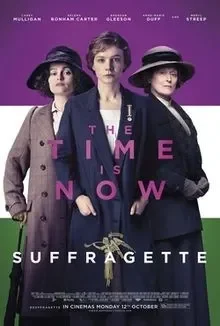
Suffragette is a 2015 British historical film about women’s suffrage in the United Kingdom, directed by Sarah Gavron and written by Abi Morgan. The film stars Carey Mulligan, Helena Bonham Carter, Brendan Gleeson, Anne-Marie Duff, Ben Whishaw, and Meryl Streep.
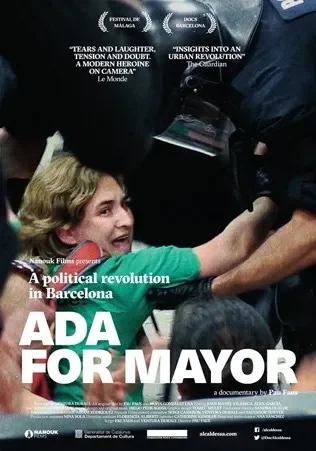
Ada for Mayor (Alcaldessa) is 2016 documentary by Pau Faus which charts the political rise of Ada Calau from feminist activist to the Mayor of Barcelona.
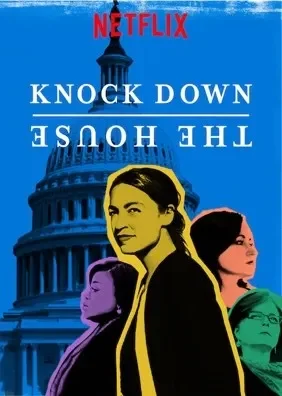
Ada for Mayor (Alcaldessa) is 2016 documentary by Pau Faus which charts the political rise of Ada Calau from feminist activist to the Mayor of Barcelona.
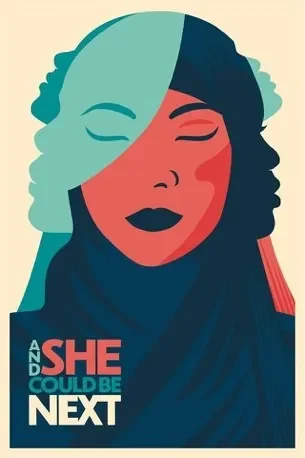
And She Could Be Next (2020) is a two-part documentary filmed throughout 2018 and 2019 by women filmmakers of color that explores the political lives of a number of women political figures in the United States such as Stacey Abrams, Rashida Tlaib, and Bushra Amidala.
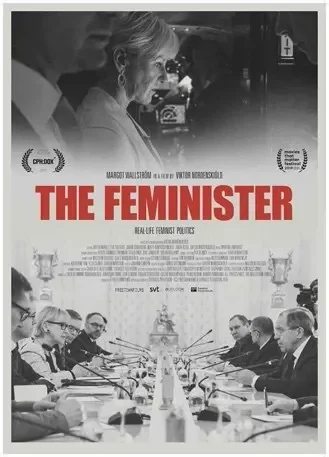
The Feminister (2019) is a documentary made by Viktor Nordenskiol of Margot Wallström, during her tenure as Swedish Minister of Foreign Affairs. The filmmaker follows her four-year term as she pursued a ‘feminist foreign policy’ and put women’s rights on the agenda whenever she could; antagonized Israel by recognizing Palestine, and criticized Saudi Arabia. She was also secretly involved in negotiations between the United States and North Korea and endeavored to have Sweden elected as a non-permanent member of the UN Security Council.
Reading List
Bjarnegård, Elin and Meryl Kenny. (2015). ‘Revealing the “Secret Garden”: The Informal Dimension of Political Recruitment’. Politics and Gender 11:4: 748–753.
Cornwall, Andrea and Anne Marie Goetz. 2005. Adding Women in Democratizing Democracy: Feminist Perspectives, Democratization, 12 (5): 783–800.
Dahlerup, Drude. (2013). Women, Quotas and Politics, London: Routkedge.
De Alwis, Malathi. (1995). ‘Gender, Politics and the Respectable Lady’, Unmaking the nation: the politics of identity and history in modern Sri Lanka, Colombo: SSA
De Alwis, Malathi, and Kumari Jayawardena. (2001). Casting Pearls: The Women’s Franchise Movement in Sri Lanka. Colombo: Social Scientists Association.
Dovi, Suzanne (n.d.) Can Democracy Work for Women? Paper presented at the 2006 Annual Meeting of the Midwest Political Science Association, Chicago.
Emmanuel, Sarala. (2018). Making Ripples in Public Political Space: The Entry of Women into Local Government in Post War Batticaloa”. Groundviews,org. https:// groundviews.org/2018/02/10/making-ripples-in- public-political-space-the-entry-of-women-into-local- government-in-post-war-Batticaloa/.
Kodikara, Chulani (2009). (2009). The Struggle for Equal Political Representation of Women in Sri Lanka: A Stocktaking Report for the Ministry of Women’s Empowerment and the United Nations Development Programme, Colombo: UNDP, 2009.
Liyanage, Kamala. (2005). ‘Women in Local Self Governance in Sri Lanka: Problems, Dilemmas, and Challenges.’ In Excluding Women: The Struggle for Women’s Political Participation in Sri Lanka. Colombo: SSA.
_______. (2018). ‘Testing the Politics of Presence: Women’s Representation in Local Government in Sri Lanka.’ In Women Governing Institutions in South Asia, ed. N. Ahmed.
Ludwig, Gundula. (2018). Post-democracy and gender: new Paradoxes and old tensions. Distinktion: Journal of Social Theory 19(1): 28–46.
Padmasiri, Buddhima, and Samanthi Gunawardana. (2018). From Associational to Electoral 20 Politics: A continuation of the land rights struggle in Paanama, LST Review 29 (345): 20–27.
Pateman, Carol (1998). Sexual Contract, Cambridge: Polity Press.
Pateman, Carole. 1989. The Disorder of Women: Democracy, Feminism and Political Theory, Stanford CA: Stanford University Press.
Peiris, Pradeep. (2021). Catch-All Parties and Party-Voter Nexus in Sri Lanka, London: Palgrave Macmillan.
Phillips, Anne. (1992). ‘Must Feminists Give Up on Liberal Democracy.’ Political Studies XL: 68–82.
Satkunanathan, Ambika. (2012).‘Whose Nation? Power, Agency, Gender and Tamil Nationalism.’ Sri Lankan Republic at 40: Reflections on Constitutional History, Theory, and Practice, A. Welikala, ed., Centre for Policy Alternatives.
Verge, Tania. (2015). ‘The Gender Regime of Political Parties: Feedback Effect between “Supply” and “Demand”.’ Politics and Gender 11:4: 754–759.
Vijeyarasa. Ramona. (2020). ‘Women’s Absence in Sri Lankan Politics: Lessons on the effectiveness and limitations of quotas to address under-representation.’ Women’s Studies International Forum 81: 1–9.
Wickramasinghe, Maithree and Dr. Chulani Kodikara (2012) Representation in Politics: Women and Gender in the Sri Lankan Republic, Sri Lankan Republic at 40: Reflections on Constitutional History, Theory and Practice, A. Welikala, ed., Centre for Policy Alternatives. http://constitutionalreforms.org/wp-content/uploads/2020/03/Representation-in-Politics1.pdf
For further reference:
An article on Sandya Ekneligoda’s struggle for justice that Dr. Chulani Kodikara posted on Polity. — http://ssalanka.org/dissident-memory-democratic-citizenship-sandya-ekneligoda-struggle-justice-chulani-kodikara/
The Curator: Dr. Chulani Kodikara
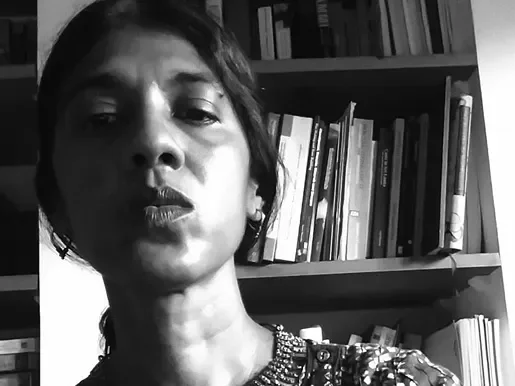
Dr. Chulani Kodikara has just completed her Ph.D. at the University of Edinburgh. Her thesis is titled ‘Inscriptions and Erasures, Grief, Hope, and Rights: A struggle for truth and justice for disappearances in postwar Sri Lanka’. She was previously a researcher with the Consultation Task Force on Reconciliation Mechanisms (which conducted public consultations on the design of transitional justice mechanisms in Sri Lanka), the International Centre for Ethnic Studies, and the Muslim Women’s Research and Action Forum. She is the author of Muslim Family Law in Sri Lanka: Theory, Practice, and Issues of Concern to Women and Women and Governance in Sri Lanka (with Kishali Pinto Jayawardena)
