

Narrative Reading List on Women and the City
The Narrative Reading List was developed by Iromi Perera, Meghal Perera and Piyumi Wattuhewa from Colombo Urban Lab for EverystoryIntroduction
“Any settlement is an inscription in space of the social relations in the society that built it.... Our cities are patriarchy written in stone, brick, glass and concrete." Jane Darke, Geographer
Cities have historically been planned for and by men. From the 1970s, architects, geographers and feminists have questioned the impact of such a built environment on women, exploring what it means to be a woman in anurban space and what struggles and opportunities women encounter in these environments. As urbanisation increased in the 19th century, so did concerns about women’s place in these unfamiliar crowded environments, as cities offered a degree of freedom and agency to women, from economic opportunities to romantic encounters.
Colonial cities were often missing women and Colombo was no different, as early migrants were often single men migrating to the city in search of fortune. In fact it was only in the 1960s, centuries after its founding, that Colombo’s gender ratio caught up with the rest of the country. Nihal Perera charts the transformation of colonial Colombo from a white male city to one with both European and indigenous Lankan women through processes of interracial marriage and missionary schools. In Sri Lanka, the city has been seen as a Westernised and modern space contrasted with the village as a site of national authenticity. Cultural narratives have often positioned women in Colombo as corrupted and Westernised: Harshana Rambukwella discusses common trope of a young man from a village losing himself through contact with the city and the sexually promiscuous (often Eurasian) women who inhabit it.
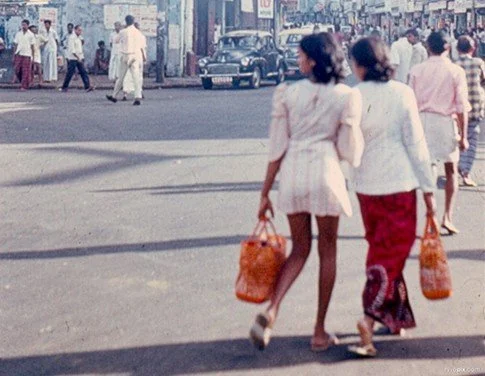
Colombo in the 1970s
Home Work?
Architect Dolores Hayden observed that a century of urban planning was informed by the principle that ‘a woman’s place is in the home,’ noting that these “dwellings, neighbourhoods and cities designed for homebound women constrain women physically, socially, and economically.” These cities were designed for the model of a male breadwinner commuting from the suburbs to an office in the city, returning to an oasis of domestic bliss governed by his wife. The city was a masculine space of economic activity, work and production, while the home was the worker’s refuge. Home is a site of shelter and nurture, the site of essential domestic labour that enables life and work to continue. Whether referred to as social reproduction or care work, the mundane tasks of cooking, cleaning, laundry, taking care of children and elderly are performed mostly by women at home.

1950s advertisements promoted and reflected the gendered divide of space and roles.
Making and running a home is no easy task, especially in the cities of the global South where infrastructure and service delivery may be insufficient, fragmented or non-existent. Where the grid is overburdened or absent, women often do the work of making sure their households have access to water, electricity and sanitation. This was particularly so during COVID-19 and Sri Lanka’s economic crisis. Washing clothes by hand, foregoing nutritious food, cooking on hazardous wood-stoves to save gas, were all strategies that women adopted to navigate the crisis which had a disproportionate impact on low-income urban households who relied on daily wages and often had higher costs of living than their rural counterparts. Meghal Perera reflects on the electricity consumption of the working class poor in Colombo, examining the impact of tariff increases in 2022 – 2023 and its impact on women and their time poverty.
Writing about how care is intrinsically linked to housing, David Madden notes that “every time a public housing development is demolished or a household is evicted, some piece of care infrastructure is shattered and needs to be rebuilt at cost. The contemporary city is battered by a relentless churn, which forces households to repeatedly build and rebuild structures and networks of social support.” In Sri Lanka, displacement has had a disproportionate impact on women in urban settlements. Even the possibility of eviction can send ripples through communities, with women again bearing the brunt. Asha Abeysekera describes how women in a low-income settlement in Slave Island face hostility and violence from their brothers, husbands and in-laws as inheritance disputes come to a head due to looming evictions and anticipated compensation. Relocation itself is a jolting experience; networks of communal care and surveillance that made it safe for children to play outside no longer exist, narrow corridors and unlit stairs limit the mobility of teenage girls. Iromi Perera writes about how even simple tasks like laundry become fraught and contested in high-rise tower blocks in Colombo that communities are relocated to in the name of development.
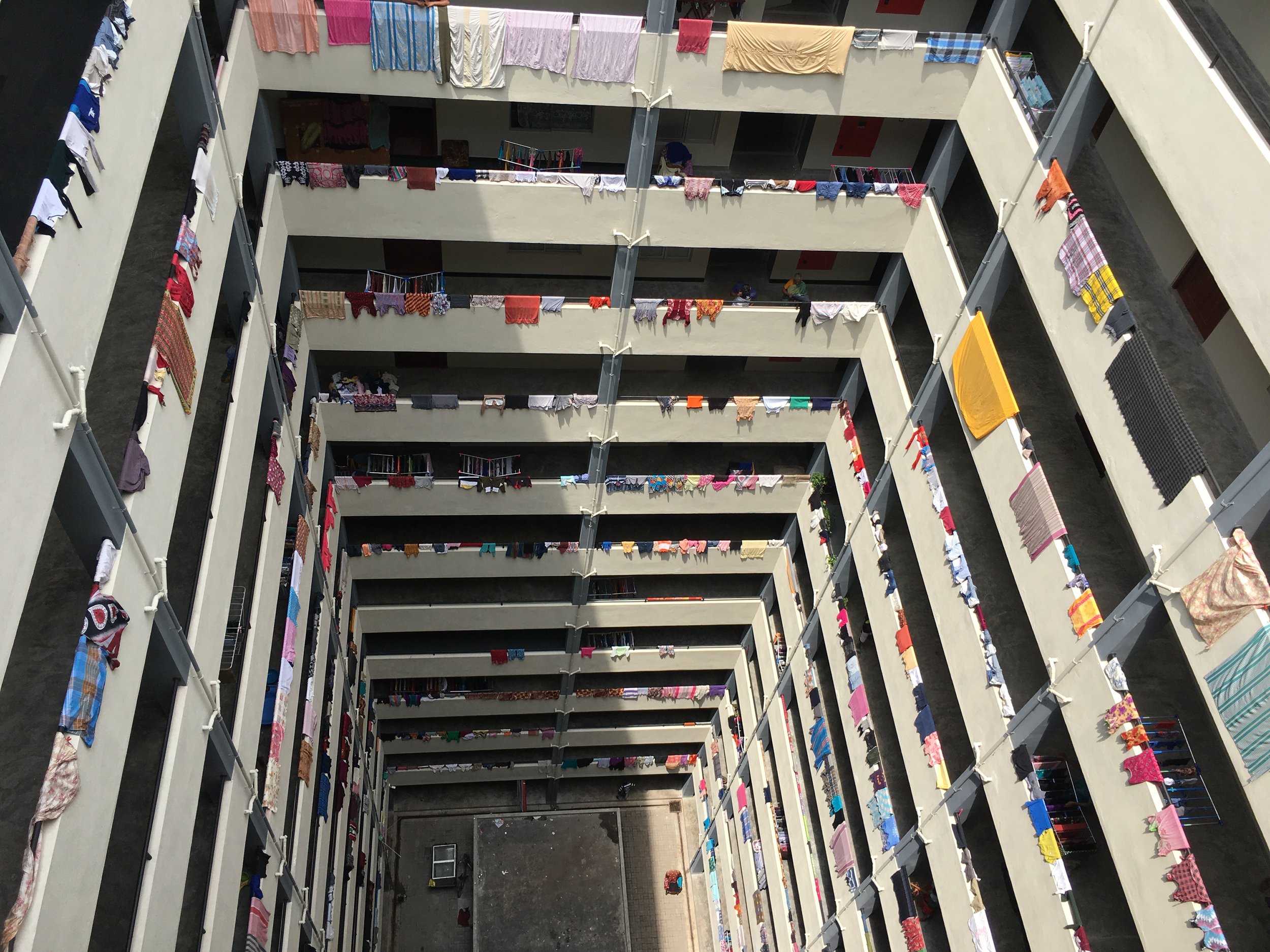
Iromi Perera looks at how relocation to a high-rise building makes the gendered work of laundry more complicated and time-consuming for women.
One approach is to think of urban infrastructures of care, which are aspects of the built environment that impede or support caregiving labour. Hayden warns us that the solutions to “overcome an environment without child care, public transportation, or food service have been "private," commercially profitable solutions: maids and baby-sitters by the hour; franchise day care or extended television viewing; fast food service; easier credit for purchasing an automobile, a washer, or a microwave oven.” The cost of these private fixes is often borne by poorer women who take on the poorly paid jobs generated by these conditions. Yet care infrastructures can be thought of in more transformative ways. For instance, the first female Mayor of Bogota, Colombia established ‘Care Blocks’ which provided integrated public services around the needs of caregivers and their dependents. Located within a 15-20 minute walk, they offer not only childcare, eldercare and job training, but legal assistance, adult education, recreation and leisure facilities. In Colombo, care remains very much within the mother’s domain, and impedes working class women from taking on full time work or formal work and their income generation activities are very much still determined by the timings and availability of day cares or school timings.
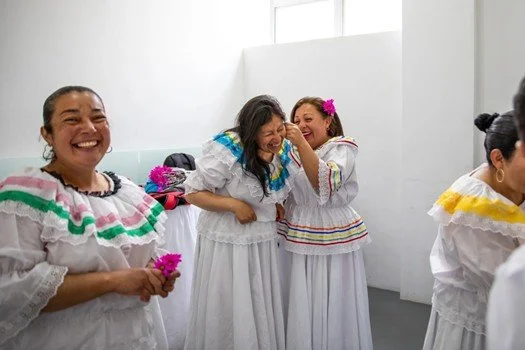
Women traditional flowing dresses for their performance at a "care block" center in Bogotá, Colombia. The class is one of the free services offered to anyone in the neighborhood who is an unpaid caregiver for their family.
While urban planners may not count on women working, the reality is very different. In the cities of the global South, a majority of women work in the informal sector, in jobs that are poorly paid and precarious. Women constitute a majority of market vendors worldwide, and often suffer as a result of spaces that have not been designed with them in mind. Female vendors often do not have access to toilets and sanitation facilities, and even when they do these are often not gender-separated which poses safety issues. The precarity of informal vending also exacerbates working conditions with women vendors facing violence and harassment from the police, male vendors and even customers, alongside the constant threat of eviction. Female-gig workers don’t have it any better, experiencing sexual violence, pollution and a lack of labour protections.
Such work is also complicated in the context of climate change and the increasing intensity and frequency of extreme heat. In Colombo, outdoor female workers are affected by heat stress in different ways: goods spoiling in the heat causes income loss, reduced water intake when they don’t have access to a bathroom and may cause infections and other health impacts. The absence of public infrastructure such as public bathrooms only exacerbates these vulnerabilities. Even in their own communities, women in low-income settlements across South Asia lack access to bathrooms which puts their health and safety at risk. Bathrooms can also be another flashpoint of sexism that is designed into the city: open-air urinals installed in Paris in 2018 were widely condemned for reinforcing the idea that only men exist in public spaces.
Mobility, Security and Reclaiming the City
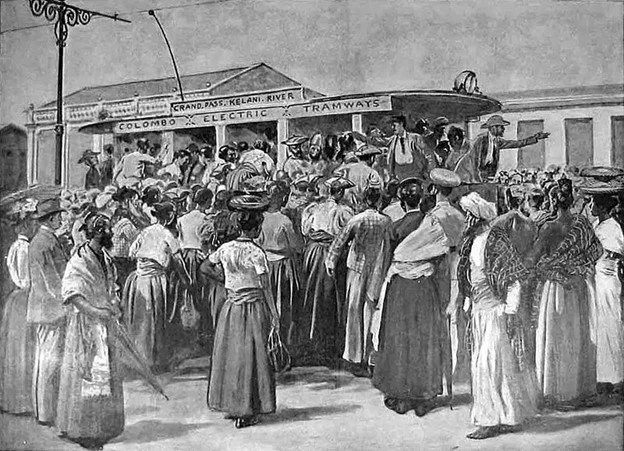
Women’s mobility in the city is influenced by a variety of factors. Women have different transport patterns from men, often taking additional trips to take care of domestic responsibilities and caregiving, rather than a straightforward commute to office. They are also more likely to take more walking trips than their male counterparts. Given that women are often confined to the domestic sphere in places where gender roles are rigid, efficient and affordable public transport can have a huge impact in increasing women’s mobility. Karnataka’s Shakthi Scheme, which provides free rides to all women and trans people on state buses, resulted in women having more financial independence, joining the workplace and taking trips for leisure for the first time.
The threat of gender based violence also looms over women’s transport choices. A UNFPA study found that 90% of Sri Lankan women had experienced some form of sexual harassment on public transport. Such experiences can have ripple effects into all aspects of women’s life. Long commutes may dissuade women from joining the labour force, while time-poverty of caregivers may increase as they have to accompany female children to places on public transport. Ride hailing apps may facilitate women’s mobility, particularly at night, but also come with their own risks.
In light of the threat of gender based violence on public transport, many cities have adopted female-only carriages and buses as a means of ensuring women a safe journey, including those in India, Japan and Iran. While such measures may ease anxieties around public transport, critics note that sex-segregated transport does not address behavioural change and reinforces the idea that men and women cannot exist in the same space without gender based violence.
Many scholars have argued for a new approach to how we think about women’s safety in public places. They note that safety for women is a goal that can be co-opted by patriarchal forces to reinforce gender stereotypes and limit freedoms of women. What would happen if we abandoned viewing women and the city solely through the lens of potential violence? Shilpa Phadke and Sameera Khan argue that a right to risk is a more liberatory goal which grants women unconditional access to public space. Under this logic, women, like men, can access the city even at night, because they have the right to public space and its pleasures. Reorienting the city as a place of pleasure, joy and fun can be a means of attacking the original logic that would see women’s place in the kitchen. In their seminal work, Why Loiter? Sameera Khan, Shilpa Phadke and Shilpa Ranade make the case for women’s right to loiter in the city, as men do all the time. Only through loitering, or existing in space without a legitimate or respectable reason, can women reclaim urban space and the full citizenship that comes with it.
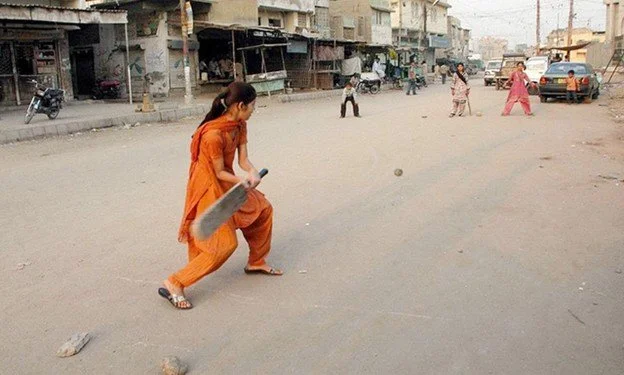
Why Loiter has inspired initiatives like #GirlsatDhabas and #GirlsPlayingStreetCricket through which women and girls across South Asia reclaim urban spaces.
Resources
Books
Feminist City: A Field Guide by Leslie Kern
Cities, Slums and Gender in the Global South - Sylvia Chant, Cathy McIlwaine
The Death and Life of Great American Cities by Jane Jacobs
Why Loiter?: Women and Risk on Mumbai Streets by Shilpa Phadke, Sameera Khan, and Shilpa Ranade
Urban Undesirables: City Transition and Street-Based Sex Work in Bangalore by Neethi P. and Anant Kamath
Articles
Feminism and the Politics of the Commons - Silvia Federici
Dangerous Liaisons - Shilpa Phadke
Women’s search for public space and leisure in Agra: cots, courtyards, and riverbank - Mahima Taneja
Gender, public space and social segregation in Cairo: of taxi drivers, prostitutes and professional women- Anouk De Koning
Gender, space, and resistance: street vendors of Dhaka city - Meheri Tamanna, Kyoko Kusakabe, Joyee Shairee Chatterjee & Vilas Nitivattananon
Making Colombo Intimate - Mihirini Sirisena
What it’s like being a female tuk-tuk driver in Sri Lanka - Zinara Rathnayake
Can Fun Be Feminist? Gender, Space and Mobility in Lyari, Karachi - Nida Kirmani
On Building Cities for Women and the Early Days of Feminist Architecture
Flâneuse: Women Walk the City in Paris, New York, Tokyo, Venice, and London - Lauren Elkin
Watch
What Would a Feminist City Look Like?
Listen
She Builds: Episode on Minette De Silva https://www.shebuildspodcast.com/episodes/minnettedesilva?rq=minette
The Feminist City https://vidhilegalpolicy.in/podcasts/the-feminist-city-trailer/women-in-the-platform-economy-with-dr-sarayu-natarajan-part-2/

Centre for a Smart Future is an interdisciplinary public policy think tank based in Colombo, Sri Lanka. We conduct high quality research, promote collaboration across disciplines, and generate actionable ideas. We like being interdisciplinary and imaginative in how we think about challenges and solutions.
The urbanisation and cities theme at CSF is led by Colombo Urban Lab (CUL). CUL works towards equitable and sustainable cities in Sri Lanka by advocating for research driven policy making where the lived experiences of citizens form the basis of a city’s development. It is a collaborative and interdisciplinary space, enabling connections between research, practice and public policy. Our research and advocacy themes include infrastructure, food environment, climate change, social security and public space.
