
16th May 2024
Interview By: Miriam Alphonsus
Written By:Miriam Alphonsus
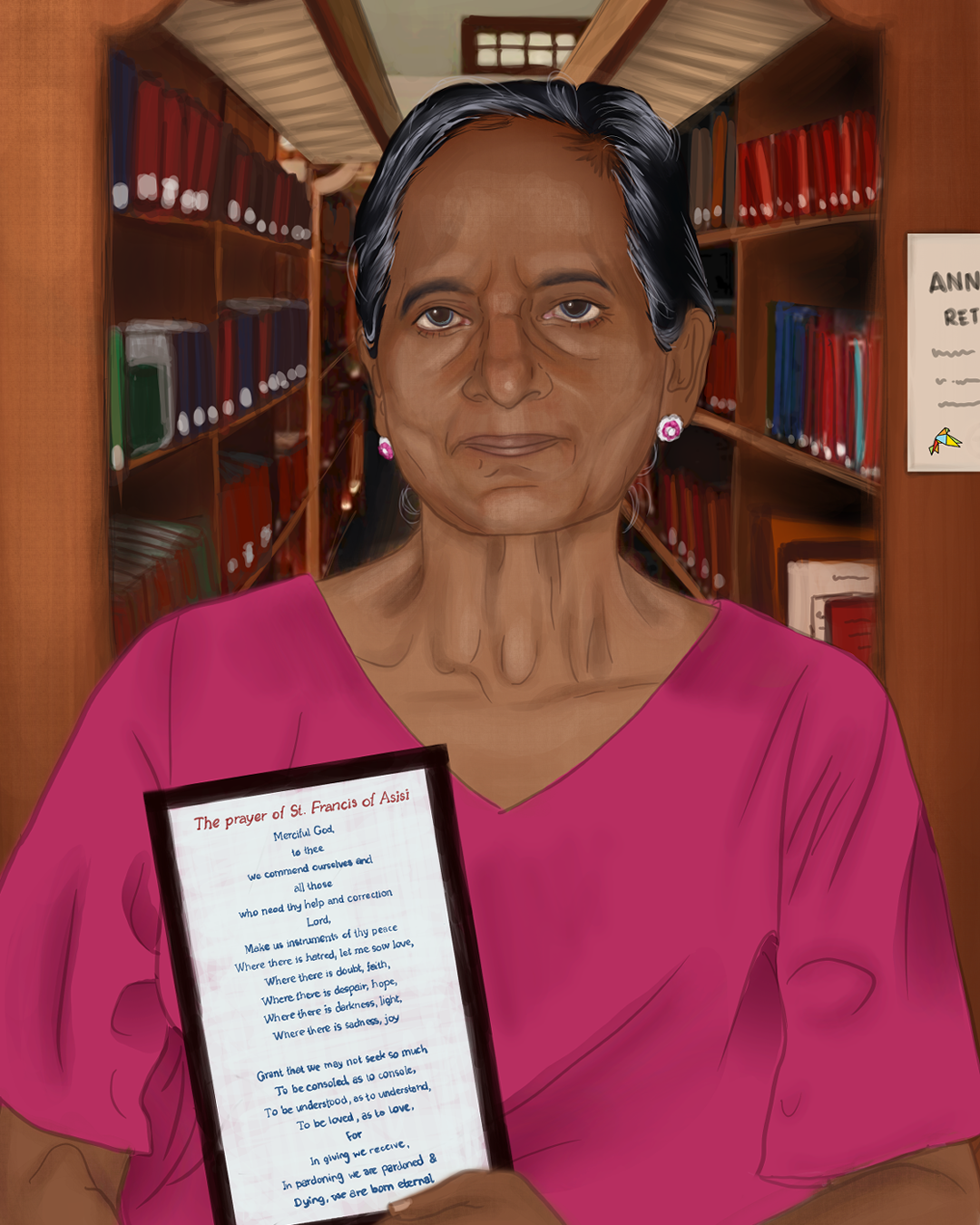
Illustration by Nathasha Wickramasinghe
Kirupaimalar Hoole Sellathurai has lived many lives, but her spirit of learning and service has remained constant. Throughout her time as a caring teacher, meticulous librarian, and devoted wife and sister, Mrs.Kirupa Hoole has moulded the hearts of students and readers in Jaffna and across Sri Lanka.
Mrs. Kirupa Hoole dedicated herself from a young age to a life of service. As a child, she would read the Tamil Christian Magazine Puthiyur, published from Tamil Nadu since 1949, for their daily family devotions. “On one day the devotion was about the Sermon on the Mount,” she explained, “Jesus says “blessed are those who mourn, for they will be comforted.” Then the thought for the day [in the magazine] which her father read out was “to help those who suffer and in need, God has placed you as aids in this world;” she concurred, ‘That moved me and constantly stayed in my mind.’
Kirupa Hoole’s sister, the eldest in the family, lived with a disability; her elder brother had polio. As a result, she learned responsibility and care, while being the youngest in the family. To support her sister, she got a job in Nigeria as a teacher which required her to travel and live alone far away from home, something that was not typical for women at the time. She credits her parents for never feeling restricted by her position as a woman, reflecting how “even though we came into ideologies of Marxism later, it was my upbringing, that gave me, the foundation of courage and adaptability to live in this world.” The compassion she learned in her childhood would provide her with a foundation of courage that she would need later in life.
Born in Jaffna in 1955, Mrs. Kirupa Hoole blossomed into adulthood in a politically tumultuous period. In 1983, as the civil war had begun, her love story commenced with a proposal of marriage, lasting two tumultuous years with her mother in law, who was, via letters, briefing me about her son during the time, while this country was sliding into a civil war; she was in Nigeria, finishing her contract, and at the end of it married Rajan Hoole in 1984. One of his conditions was that he would like to get back to Jaffna, that I too would become a vegetarian and allow him to do human rights work apart from his Mathematics career, which she accepted willingly thinking he is doing something good for the society.
In 1985 at the end of his contract in Singapore, and the couple returned to Jaffna, and settled into domestic life, at a time the militant movements were on the rise, engaging in lethal reprisals to the attacks of the tri-forces. The couple witnessed all the problems going on between the militant movements as well as the government atrocities and the suffering of the people.
In 1986, the LTTE was focused on annihilating fellow Tamil Nationalist groups and gaining a monopoly of power once the battle is won or lost, increasing the likelihood of the latter. Mrs. Kirupa Hoole recalls how this proved to be a defining moment both for the Tamil struggle and her personal life, “it struck us that we won’t achieve anything after this given how we have destroyed our own people and weakened ourselves.”
In 1988, her husband and few other lecturers at the University of Jaffna started the University Teachers for Human Rights (Jaffna), UTHR(J), an organisation dedicated to reporting on atrocities during Sri Lanka’s civil war without fear or favour. She remembered that Rajan used to tell his students “I believe that you can’t just study in a vacuum in the university. It is crucial to be aware of things going on around us” she explains, “we saw in 1987 the Vadamarachchi operation and later when the IPKF came in 1987, they tried to raise awareness about these atrocities.”
Through her support of this politically sensitive work and the personal struggles of her own family, she found herself in challenging situations. In September 1989, Rajini Thiranagama, one of the founders of UTHR(J), was assassinated, forcing Mrs. Hoole and her husband to move to Colombo for their safety. “You can’t think a lot during war,” she recalls, but the couple had to decide what to do with their lives and careers in the aftermath of such a profound personal and professional tragedy. Herhusband Rajan Hoole told her “After this happened to a friend, I can’t just abandon the cause; I must do what I can to achieve her goals and vision.” And he can’t leave the country, she says, and as it were, the couple’s spirit would again survive the test of fear as they continued their work from Colombo.
UTHR(J) went semi-underground, and during a year’s stint in the UK, Kirupa Hoole read a Master’s in Business Information Systems at East London University with the intention to find work. Upon returning to Sri Lanka in 1993, she volunteered initially at the Open University. She recalls how she once told her Librarian, Mrs. Sriranjani Korale, at the OU that she is not a good reader, only to be told that it's alright as what she wanted in the 1990s was computerization of the library, and encouraged her to take up a position first as an Assistant librarian in her maiden name for security reasons. There she improved the library collection with search facilities on OPAC (Online Public Access Catalogue), and introducing library management system and online access. Mrs. Kirupa Hoole recalled how her subsequent Masters’ studies and brief stint of training as a computer programmer at OU, helped her support the IT revolution of library systems in the 1990s (I was of course introduced to computer programming early after my degree in 1979 under Dr.Maya Sittampalam at A to Z computers).
Latterly, she would help develop and digitise the library over her interrupted career of twenty years as a senior librarian and trained the library staff and students too. Kirupa Hoole held dearly what she learned at the Open University and Harvard University libraries during her husband’s time as a visiting scholar in 2004.
After the war ended, upon their return to Jaffna in 2010, using the knowledge she gathered over the years, she voluntarily digitised the St. John’s college library. Later since 2012, as a senior librarian at Jaffna University, by that time library management systems were established, she sought ways to improve the OPAC for efficient search and access online resources. Nevertheless, her experiences have also led her to be cautious about technology in education and learning.
However, in Mrs. Kirupa Hoole’s view, “IT has deskilled people in some ways from reading enough.” She lamented that children, particularly those whose education was disrupted by the war, no longer pursue the quiet and time-consuming passion that reading is, “if children are always studying and going for tuition, it makes me think, where do children have time to read, go through what they studied and think on their own.” Reading must be encouraged from primary level, parents must read the children stories and fables from childhood, so that the they will find it easy to read and understand even their text books on their own, as they move on. It is good to present story books or other books as gifts for leisure reading and creativity.
She says, in this regard the late librarian at the University of Jaffna, Madam Srikanthaluxmy did a lot of promotion to improve reading from primary school level, collaborating with public and school libraries, having established an organisation called FOLA (Foundation Of Library Awareness) in 2005.
I am also very proud to have learned my trade under Mrs. Sriranjani Korale, a highly capable, old-fashioned librarian at the Open University, who understood the strengths and weaknesses of a typical university collection and ensured careful selection of books for the library. This quality is sadly dying out – for whom books, their authors, browsing through and classifying them is an undying passion while book selection is an important tool for a high quality library collection.
At the Open University, later at the Jaffna University, in her church, and with her family, Mrs. Kirupa Hoole made it her mission to encourage reading and the love of books.
Community is very important for Mrs. Kirupa Hoole. When she and her husband moved to Colombo in the 90s and were forced into a somewhat secretive life, she credits living with the family of their colleague, Sritharan who was a co-author of Broken Palmyra, for keeping life hopeful in spite of the insecurity around them. In helping care for Sritharan’s children and other colleagues of the same plight, Mrs. Hoole found strength during dark times. Mrs. Hoole’s own grandmother, Mrs. Ramalingam, hugely influenced her outlook on the family as she delicately united and sustained the many children and grandchildren. “My grandmother’s living example helped me not to worry about not having children but to do what children long for, who are either in need or needed looking after, to give them a secure childhood.”
Although a role model in her own right, Kirupa Hoole credits the many champions of justice before her for the person she became. “We grew up listening and reading stories of Indian freedom fighters like Gandhi and Nehru, as well as the stories of Mother Theresa and Florence Nightingale,” she says, adding that in real life, too, she was lucky to be surrounded by people of integrity and dedication, both in the human rights sphere, as the unforgettable colleague the late Dr. Rajani Thiranagama, and amongst her librarian colleagues. Dr. Rajani lived and died, broadening her medical ethics, even as the Tamil struggle was dominated by a force that sought the destruction of all human ethics. Hers was to strive to protect life whenever it faced gruesome threats. But our politics had become one where the difference between life and death mattered little, and a section of the school of life savers too had slipped into this under the force of ideology. As in Nazi Germany, and modern Israel, this had happened several times in the annals of humanity.
Kirupa Hoole supported her husband in all his writings, be they articles or books, and co-authored his most recent book “Democracy Stillborn” on the Malaiyaha Tamil struggle for equal rights in Sri Lanka, how their citizenship and voting rights were denied to many. She keeps informed about the many struggles for justice and equality in Sri Lanka. Having witnessed, however, the ways in which genuine struggle for justice can veer off course, Mrs. Hoole returns to God to seek guidance.
“When I think of how to go about this struggle for positive change it is a prayer by St. Francis of Assisi, a great man of peace, that I think of. He lived in times of many religions going to war, so I think it is relevant to the struggles in this country when we cannot comprehend the destruction and are trying to understand the pain, and learn to forgive, that we too are in turn forgiven.”
Reference Links and Further Reading
Libraries can help rebuild our war-torn society, https://elijah-hoole.medium.com/libraries-can-help-rebuild-our-war-torn-society-3525bc1a482d
Notes
This article is pending support to be translated into Sinhala and Tamil. Please email storiesofslwomen@everystorysl.org if you would like to support us with translations or if you have any questions.
(Miriam Alphonsus is a freelance journalist and history educator focusing on issues of race, class, and gender. She holds a bachelor’s degree in history from Harvard University. You can find her writings at the Sunday Times, Sunday Observer, The Hindu, and Harvard Political Review. Find her on X at @alphonsus_mimi)
