
5th July 2022
Interview by: Shenali de Silva
Written by: Noor Aziz, Shenali de Silva and Ashanee Kottage
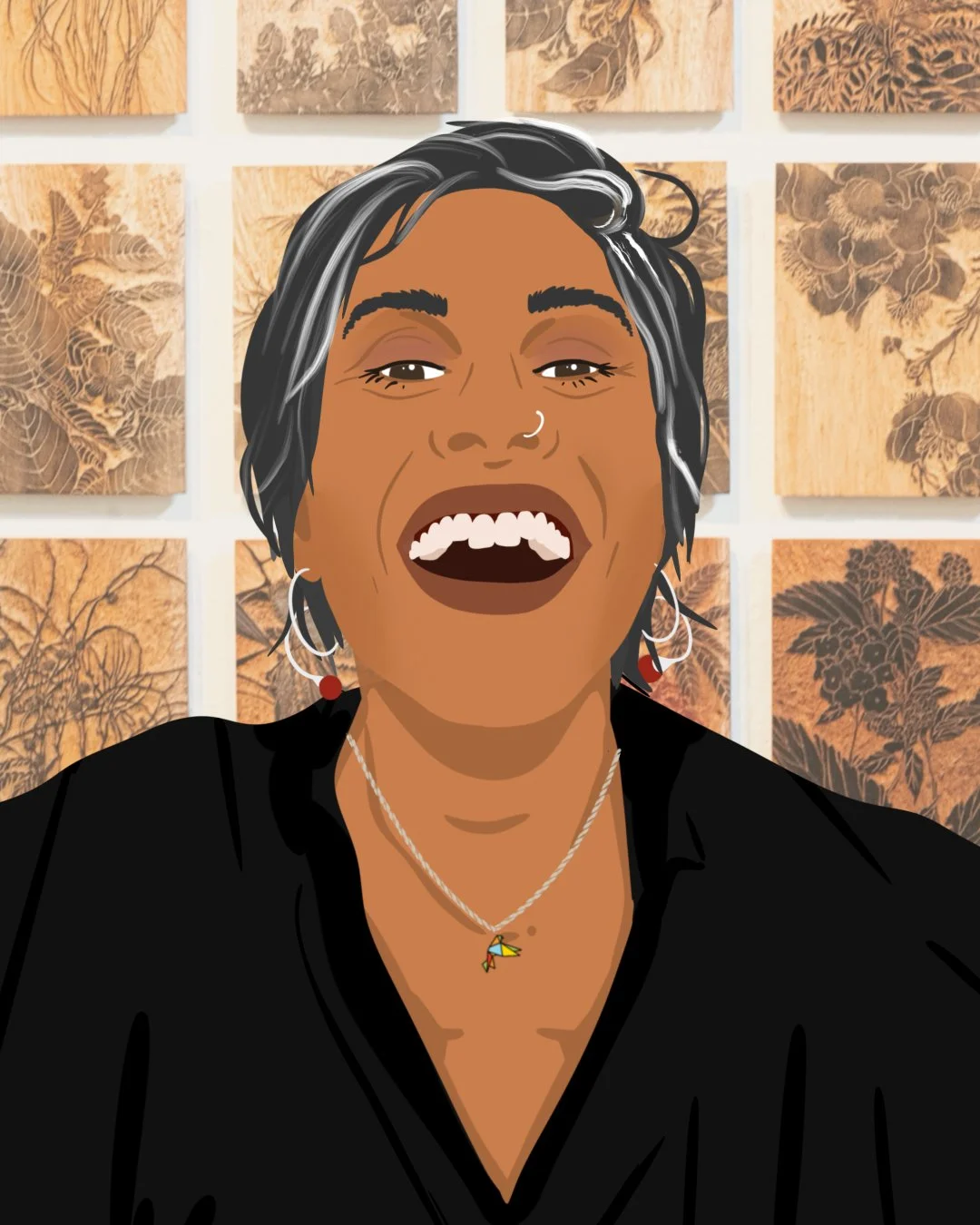
Illustration by Devni Jayakody
Layla Gonaduwa is a conduit of stories, a connoisseur of antique furniture, and a collector of weeds. She is celebrated as an interdisciplinary artist with a cathartic and tactile creative process. Her art confronts social and political perception, historical narratives, memory, and ecology through multidisciplinary practices rich in texture and detail. She describes her medium as “…drawing on flat pieces of paper, but then putting it all together, and understanding that there is tangible stuff there. The work is sculptural. Even when I am drawing on a flat plane, the pen goes and hits another surface at the end of the strip. And I use that - and it's a collective of dots. All these dots are creating… a 3D piece of art. It is a piece of work which is organic - which is growing.”
Her journey as an artist is complex and woven into a journey of self-discovery: “Sometimes I think I’m a late bloomer because, in my early years, I was trying to survive the world, my fractured family, a very limited world view. I was trying to find my path alone in the grand scheme of things. I had no role models, no women in my immediate family to shape my world. Art was just an outlet for me to escape to. It had its waves. As an introverted child I lived in my own dream world, exploring with a head full of hundreds of schemes and ideas which included grand plans of running away and building a homestead in the jungle!Then came a lull period where I understood what was expected of me as a mother and a woman, [which] was a very important part of my life because I had to fit into the norms and what was expected of me, especially in the context of Sri Lanka,” she explains.
In her 20’s Layla conformed for the sake of survival, but later she departed from the conventional Sri Lankan woman’s life, first, when she entered an inter-religious marriage and later, when she ended the marriage. This decision, she reflects now, would have been inevitable in her life at some point. The result was a free and unconfined artistic practice and lifestyle. The disruption it caused to her family and children was somehow countered by her and her then husband who chose to place their children above personal ego. But her financial standing and stability took an immense hit, one she had to live with. She also entered a volatile period in her personal relationships. Despite these hardships, she prevailed. “I could have been hateful and dwelled on my problems, but I chose not to do that, and that showed my children that family was important.”
She recalls the multiple challenges she faced both as an artist and a woman navigating motherhood in mainstream society. Early in her professional career, she was told by fellow artists: “Art and motherhood doesn’t mix.” In one of her early works, Crushed Aluminum Pot with Enamel Work for the Contemporary Women Artists Exhibition (2014), she reflects on these lived realities. In My Water Pot, she explores the structured rhythm of domestic life and the ongoing conflict between motherhood and her artistic calling. With children in tow, she made difficult but resolute choices that shaped the trajectory of her family while also affording herself the space to move forward in her work and live on her own terms.
Layla remembers the confusion she encountered from her peers for forfeiting what many would call a perfect life: "I’m often told I had a good life there, and asked why I chose to leave. The honest answer is that fulfillment looks different for everyone, though I’ve noticed women are asked to explain those choices far more often than men.”
“Despite divorce being a heavy decision, I know I showed my children how to live as authentically and truthfully as possible. I have made mistakes but perhaps also have shown my children that one can turn back and correct those or alter course. My kids have grown to be intelligent, hardworking, street smart, resilient and unfazed. They don’t shy away from hard decisions. They value truth and integrity above all else. And that, both of us parents have contributed to.” She continued.
Even as an artist, her journey has been embroiled in confrontations over her identity and self-expression within an industry covered in liberal garb. The art she produced during her "conflicting years" was confrontational and bold ahead of its time and not as well-received as it would be, today. One of Layla’s very first solo exhibitions, which included a collection of deeply personal paintings, was deemed unfit for display due to being inappropriate by some. While such incidents forced her into a shell momentarily, Layla was determined to create and complete her collection. Amidst the rejection she encountered, she fondly remembers the encouragement from a senior artist who told her, "[L]ook, you need to have this exhibition. Whether it’s good or bad, whether it’s a failure or a success. You need to showcase your work, and you need to move on." And that she did. The collection of paintings was later exhibited at the Theertha Art Gallery under the title A Quieter Place. The exhibition, unapologetic in its honest depiction of transition and selfhood, became a significant stepping stone in her professional career as an artist.
Layla has since built a successful career as an interdisciplinary artist with international acclaim. As part of her 2021 work for the series titled Facing Maha, Layla travelled across Sri Lanka documenting stories of migration from different communities. Her residency began documenting stories of migration to and from Switzerland; later, it became an exploration of how migration changes identity across Sri Lanka due to COVID-19 travel restrictions. This led to a three-month journey across Sri Lanka, where Layla witnessed the everyday happenings of communities and people along the way. Her unobtrusive integration into these communities is a testament to the intimate and poignant stories she drew out from across the island. She was awestruck by the people, places, and practices she encountered, not because they were sensational or extraordinary, but precisely because they were not. Layla was able to appreciate the beauty and sophistication in the simplicity she witnessed.
Through her work, she recalls how migration shaped the relationships and bonds that stretched across oceans and even rivers, including how such transitions create spaces for new beginnings and moments of refuge. One such story Layla reminisces of is the "kotahalu magula," an extravagant event to celebrate the coming of age of girls. Having been invited to such a celebration, Layla explains howthese celebrations have become an alternative to weddings because mothers who migrate to the Middle East seeking work are uncertain if they will return or have the financial means to organise a celebration like this again.
Layla fondly notes, “There were so many stories like that, everyday stories, which you don’t pay much attention to, but they shape what we are as a nation, they shape the community, they shape the family. And it’s important that we know these stories."
During her travels, Layla learned about Sri Lanka’s half-Muslim king, Wathhimi Wijayabahu, and how his story is a hidden one. She is amused by people’s belief that he was a Sinhala Buddhist king turned deity - Galebandara. Her excitement around this story reveals a gentle nostalgia and quiet hope for her half-Muslim children: that one’s homeland holds a multicultural history stretching back millennia. However subtle, she is able to see herself in the stories she encounters.
Layla’s intrinsic curiosity, which draws her to the unexplored, stems from her childhood adventures. She remembers how, as a nine-year-old, she would wake up at dawn to explore the neighbourhood on her bicycle, observing the everyday happenings of the people around her. "I would take all these lanes and paths, and I would go through St. Mary’s Church. Through hostels where priests would hang their clothes, they would see this girl going on a bike. It was this crazy life I had, and nobody bothered to figure it out or look at where I was. I came from a household where nobody really cared, and that was the best thing that happened to me, in hindsight. I was on the road all the time, going to Shanthi Bookshop, and buying books, to picking mushrooms in Police Park, to going foraging in neighborhood gardens, to digging the garden to make the Mahaweli river and lakes, you know, just being out there, and being curious."
A collection of weeds, flowers, and leaves pressed between the pages of Khalil Gibran’s Prophet bears testament to Layla’s fondest memories and adventures. She finds solace and guidance in the wisdom its words contain, and she finds joy in the souvenirs they hold. "Wherever I stayed or wherever I lived, I had this habit of pulling out weeds, flowers, leaves and putting them between pages. It reminds me of a place; it reminds me of a moment; it reminds me of a part of myself," she explains.
Layla’s adventures have now taken her to the icy peaks of the Nepalese mountains. Another transition made more with her heart than her head, some might say. This period carried years of uncertainty, but she endured, sustained by her indomitable spirit, work ethic, and passion for organic vegetable gardening. “I’m particularly interested in weeds and alien species entering a system. Whether they are going to disturb it or destroy it. Whether they will elevate it in a certain way or offer a second chance for the area to improve. You can equate that to migration in human terms.” Her 2021 work, as an awardee of the Pro Helvetia Swiss Artist Residency for an Asian Artist, addressed migration and the symbiotic and discordant relationships within communities and ecosystems. A concept she will further carry forward in Sri Lanka.
“I plan to take forward my art and ecology related projects of disappearing indigenous flora and culinary traditions indigenous to Lanka. As I am already familiar to a certain extent and have interest and knowledge of these traditions, it makes sense to explore it further in my own country with my husband whose interests are very similar.” Her recent exhibitions have been inspired by collective action and people’s movements; subterranean organic workings that emerge in response to surface-level politics. All infused with ecological motifs and natural processes that mirror these political undercurrents.
Layla’s life is a testament to the protest she portrays in her work. She lives unapologetically, encapsulating the fervour of nature and the energies of the communities that surround her. "The way I have lived a life without apologies is a protest in itself. The way I have brought up my children and the way I have fought for them is a protest. I have done things because I wanted to. The way you look at something is the way you will receive something. When you look at something, the refraction rate is in proportion to how much you bear or try to understand (Solo Exhibition - Angle of Incidence, 2017)".
Layla’s art, like her resistance, is embedded in the way she lives; an eclectic amalgamation of fragments, histories, and forms that somehow resolve into harmony. “My house was a mismatch of a lot of things. There is no rhyme or reason to it, but funnily enough, eclectically,it all works together. It evolves into a harmonious space of its own.”
She claims, “You live art — it's a constant. It's not a 9-5 job where you think ‘Now I’m going to make art’ or ‘Now I’m going to be a mother’. You can have that idea of working your life out like that, but it doesn’t happen that way. Just by living your life on your own terms is a form of protest, I would say.”
Her latest work in progress, Fault Lines, explores themes of collapse, impermanence, and regeneration through sculptures inspired by fractured concrete, rubble, and infrastructural remains. Blurring the boundaries between decay and growth, the work examines how human-made systems gradually erode as organic forms emerge through them, reflecting ecological and political cycles that exist beyond human control. Rather than presenting ruin as an endpoint, the project considers collapse as part of an ongoing process of transformation, adaptation, and renewal.
Layla reflects on one of her favourite weeds, the nidikumba, “Everybody considers it a weed, and if you trample it, it’s got thorns, but at the same time it has a lot of medicinal properties, it's a ground cover, and I would think that if you rip off something from the soil, it's an open wound. The earth has its own way of reproducing something to cover up that wound, so that it won’t get damaged. For me, nidikumba is just that, it's got its mechanisms of touch-me-not, and I think a lot of these plants have their own mechanisms and uses.” Her description of the nidikumba, with its quiet defensiveness and healing properties, evokes her own story and artistic practice.
Layla continues to dedicate herself to sharing stories and collecting weeds; she has grown to love the way they stain books, an art form in itself, and to her, “There’s nothing nicer than opening a page and finding something that makes you return to a memory.”
Reference Links and Further Reading
Title, Publication Platform, Date (4th September 2021), Link
Layla Gonaduwa, Instagram, https://www.instagram.com/readandseed/?hl=en
Being Away, Frustrated, Helpless – Artist Layla Gonaduwa Bares Her Soul On Sri Lanka’s Tumultuous 2022, Commonwealth Union, 15th January 2023 https://www.commonwealthunion.com/being-away-frustrated-helpless-artist-layla-gonaduwa-bares-her-soul-on-sri-lankas-tumultuous-2022/
Layla Gonaduwa, Colomboscope, https://www.colomboscope.lk/layla-gonaduwa
Upcoming Maintenance Work, Prohelvitia, https://prohelvetia.in/en/layla-gonaduwa-on-home-not-alone-residency-in-sri-lanka/
Layla Gonaduwa: Exploring Memory, Home and Migration Through Art, Groundviews, 19th October 2021, https://groundviews.org/2021/10/19/layla-gonaduwa-exploring-memory-home-and-migration-through-art/
Facingmaha, https://facingmaha.blogspot.com/
Notes
This article is pending support to be translated into Sinhala and Tamil. Please email storiesofslwomen@everystorysl.org if you would like to support us with translations or if you have any questions.
(Noor Aziz is a writer, social worker, and the Programme Manager for Stories of SriLankan Women at Everystory Sri Lanka. Grounded in psychology, social work, and gender justice, she works toward building ethical, inclusive workplaces. Driven by her love for literature, the arts, and human connection, she is endlessly curious about how culture shapes the spaces we share.)
(Ashanee Kottage is a poet, theatermaker, weaver, and researcher. She recently completed a Masters in Sustainability from Tufts University. At her core, she is a storyteller, a student of the earth, and a friend. To learn more about her work and order her debut poetry book, Sand & Sweat, visit ashaneekottage.com)
