
Women and Pleasure: A Narrative Reading List
Curated by Thadini Liyanage.

Aruni Dharmakirthi, Sweet Lover (2022), Divine Pleasures (2023)
Experiencing pleasure as a woman is a rather fraught affair, isn't it?
Whether it's having a steamy read, indulging in a beverage of your choice, or enjoying a cheeky smoke, we are often accosted with patriarchal norms and obligations. Beyond the endless list of 'duties' we must perform, the world is constantly telling us what is appropriate for women to desire. That is to say, the plethora of things we’d like to enjoy often conflict with what we are “allowed” to pursue. And nowhere is this truer than sexual pleasure — the one thing women are told, above all else, not to talk about and certainly not to enjoy.
This work reflects on the encounters South Asian women have with pleasure - something that is messy, confusing, and often feels fairly abstract. I hope it creates a space for you to reflect on your experiences with pleasure.
An interesting point of entry (pun intended) into this intersection of patriarchy and women’s pleasure is the infamous story of Kalu Kumaraya, the Black Prince of Sri Lankan folklore. There are a few versions of Kalu Kumaraya’s legend. Some say he preys on young girls and pregnant women; while others say he appears to women in dreams, seducing them to such a state of ecstasy that they beg for death. For me, the latter is far more appealing — it’s clearly talking about women having wet dreams, don’t you think?
To this point, I found Gananath Obeyesekere’s book, Medusa’s Hair: An Essay on Personal Symbols and Religious Experience, particularly interesting. Granted, Obeyesekere’s work is not solely an examination of women’s pleasure, but the case study he uses to explore the lore of the Black prince provides an intriguing commentary on the subject.
“A beautiful sensation of jasmine flowers, a cool wind strikes me, and I feel awake, though actually I am asleep. This young beautiful man comes into bed with me, and I enjoy sex with him.”
(Sirima as cited in Obeyesekere, 1984)
As young girls, we are often warned about such ‘scandalous’ dreams. At some point in your life you may have heard your Amma, Achchhi or a relative say, in a voice dripping with concern, “හ්ම්, මේ ගොන්මන් වෙලාවේ ගෑනු ළමයි තනියම ඉන්න හොඳ නෑ නේ”. It raises the question: what compels people to think this way? I would argue that this reflects our patriarchal society where desire is seen as so external to womanhood that it can only be understood through the lens of demonic possession.
This points us not only to how deeply female pleasure is rooted in taboo, but also to the general absence of pleasure in social depictions of womanhood. Here the “good woman” is not a sexual one. She is motherly, caring, and pure, which compels her to sit staunchly outside the sexual. From a South Asian perspective, pleasure remains politically charged as women’s distance from it has been historically produced in intentional ways. Which brings me to my central question: how did women become alienated from their own pleasure?
The Making of the “Good Woman”
It’s family movie night, and it suddenly gets awkwardly silent. Only the sensual moans of the actors on screen cut through the tension as your dutiful amma’s hands cover your eyes. You see, the logic was sound: girls really shouldn’t be watching “these things” (for those of you wondering, that’s anything beyond a kiss). Partha Chatterjee’s text, The Nation and Its Fragments, is an insightful read on the phenomenon of why women are rarely allowed to know pleasure.
He argues that nineteenth-century Indian nationalism split the world into two territories: the material (economy, science, politics) and the spiritual, the untouched inner "essence" of a culture that colonialism could never be allowed to reach. Home became the custodian of that spiritual essence. And woman, Chatterjee writes, became the home's living representation: "The home in its essence must remain unaffected by the profane activities of the material world—and woman is its representation." She could be modernised, even educated, but only so long as she stayed untouched, spiritually, by anything the material world might corrupt her with. Sex included.
Malathi De Alwis’ study of Sirimavo Bandaranaike and Hema Premadasa’s political careers reveals that both women were sexualised and morally attacked the moment they stepped beyond their assigned role as "respectable ladies". The armour of respectability allowed them to escape the physical confines of domestic life. However, "respectability" soon proved to be a double-edged sword as it only allowed for a loose straddling of both the public and private spheres while still enforcing its binary categories of pure/impure or wife/whore. For instance, when Sirimavo Bandaranaike was elected leader of her party in 1960, a counter discourse of rumours and cartoons (orchestrated by the rival UNP) circulated portraying her as having borne her children out of wedlock and as sleeping with a Left party leader she was courting for a political alliance. The international press was no kinder: Lausanne newspapers ran photos of her looking pale and shadow-eyed while campaigning, describing her with terms like "volupteuse" and "seducteuse." De Alwis links this binary directly back to Chatterjee's work on the bourgeois woman in postcolonial nationalism.
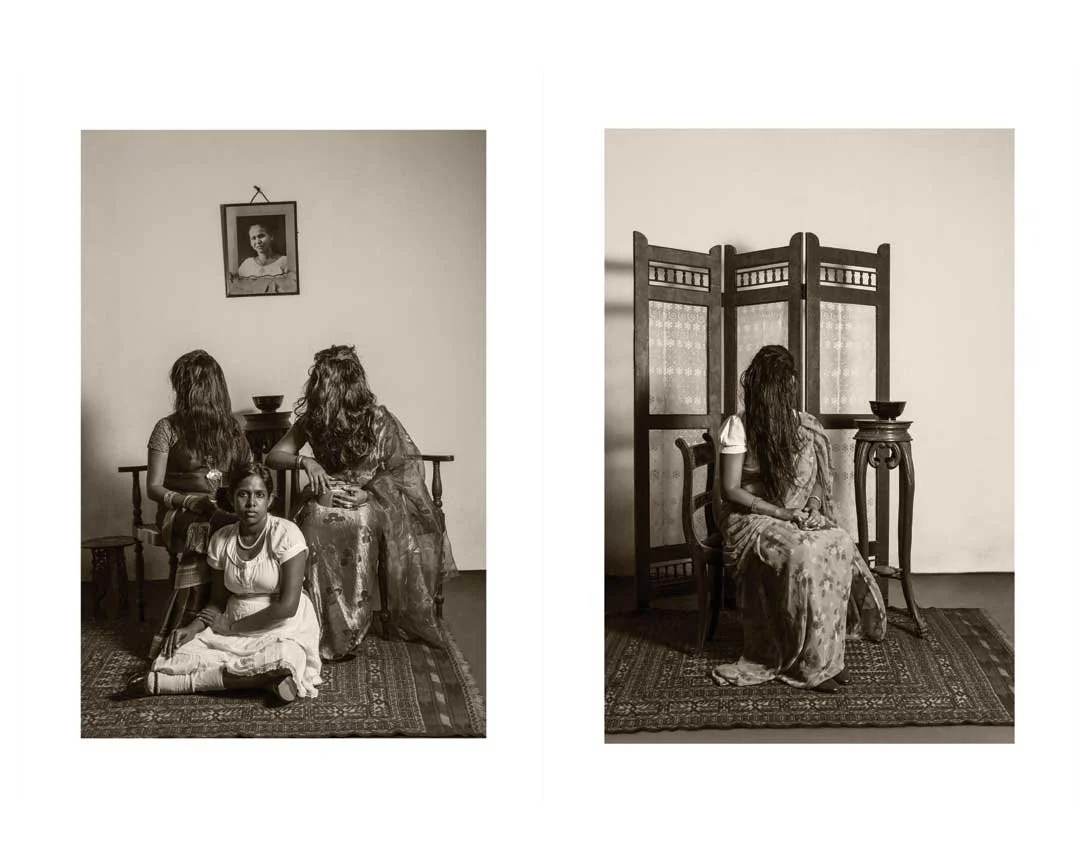
Anoli Perera, I Let My Hair Loose: Protest Series (2010)
Another interesting vista through which to examine the construction of the "good woman" is dress. Nira Wickramasinghe's Dressing the Colonised Body shows how the social architecture of the “good woman” was stitched into the very clothes they wore — Sri Lankan nationalists designated the osariya as the sole "authentic" dress for women precisely because it symbolised untouched purity, while men's clothing allowed more freedom to express political defiance against colonial rule.
The framing of the good woman was abundantly clear in Sri Lankan cinema as well. Sunila Abeysekera's analysis of three major Sinhala films from the 1990s — Mee Haraka, Seilama, and Maruthaya — traces this binary (particularly with regard to class) in cinema: the village woman as virtuous, devoted, and asexual, "a sexual non-being" who exists only to submit to male desire, against the city woman as vamp, temptress, “loose” and sexually active, therefore dangerous. Sunila Abeysekera notes that the village woman's tied-back hair and saree were "physical/visual manifestations" of nationhood itself, while the city woman's short hair and Western dress marked her as everything "alien and non-national", the same ideological work Nira Wickramasinghe traced through the osariya.
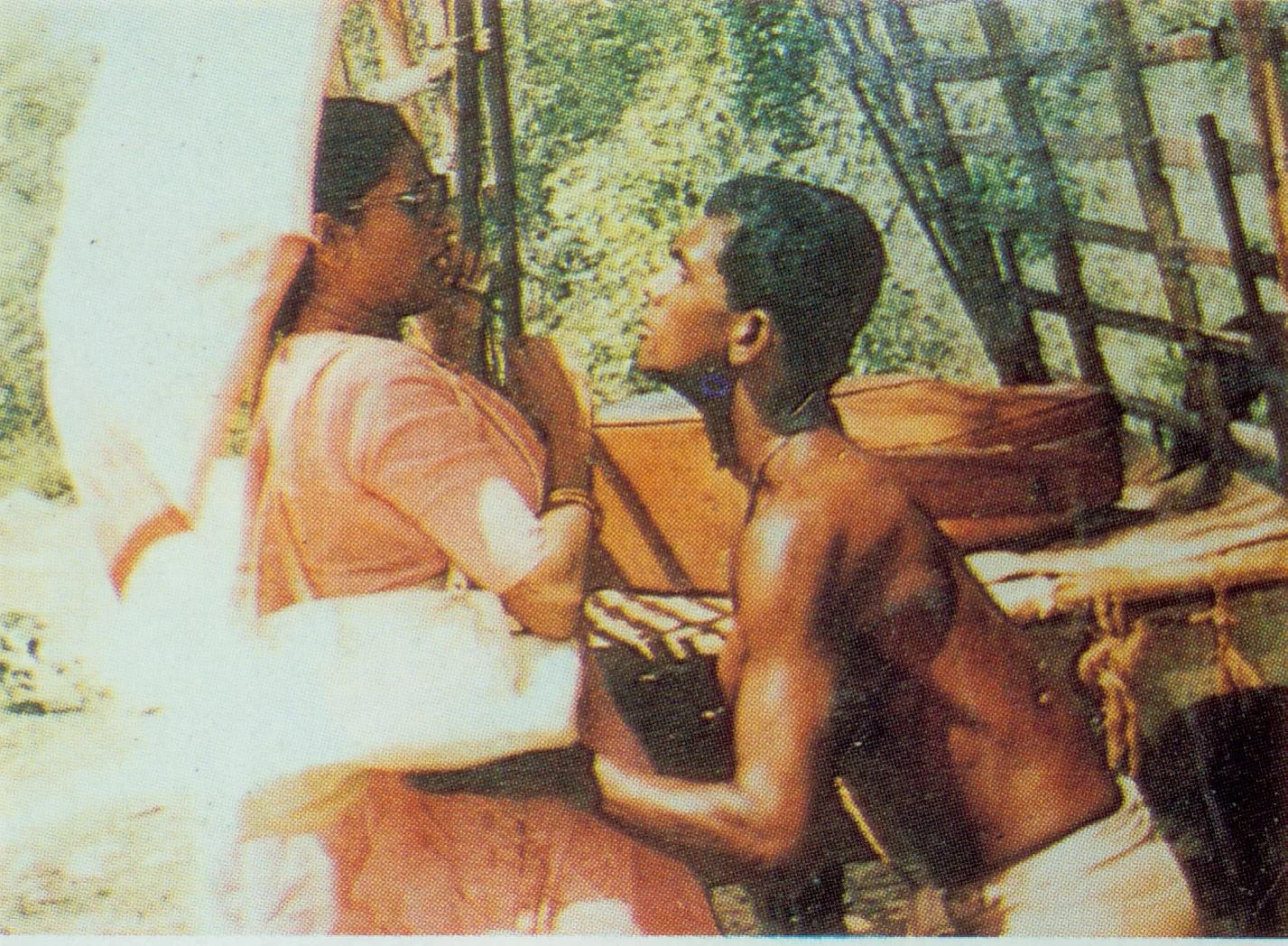
mee haraka (1993)
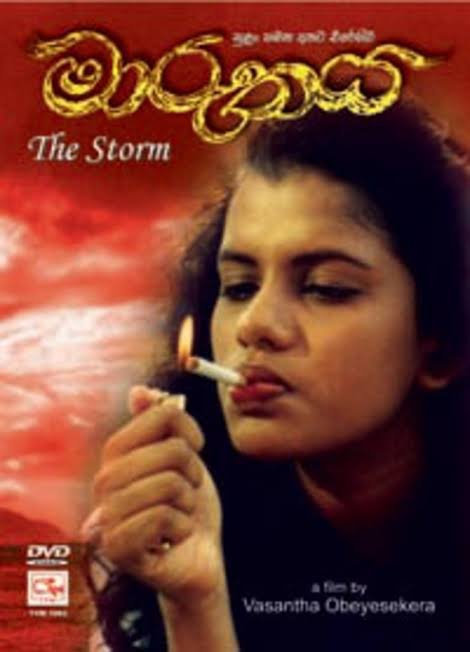
maruthaya (1995)
A culmination of various moving parts has resulted in the creation of the “good woman” archetype—one who is expected to be a pure, goddess-like figure removed from pleasure. The discourse of pleasure and the language that surrounds it has always been kept at an arm's length from us. We are inundated with sermons about the importance of Lajja-baya, shooed away from erotic material (for example, the Mills and Boon books I’d steal from my mother), and forced to be without pleasure. The “good woman” then is impossibly pure and delectably chaste.
Reclaiming the self
Ever been on the receiving end of a chorus of චි’s in response to your astoundingly offensive question, do y’all masturbate? I have. Needless to say, it was a fairly embarrassing experience which was immediately shrugged off with a resounding, “Neither do I”. When the reaction to your pleasure is such overt disgust, it often instils in you a shame so deep, you become estranged from your own body. Any attempts to explore it immediately conjure mental images of disapproving faces and that disgust-riddled chorus. Besides, if the sheer notion of masturbation provokes such a response, it’s clear that we lack the space to discuss pleasure. As such, even if you do choose to explore your body, you often have no one to talk to about it- women are frequently denied community when it comes to pleasure.
How then do we begin to resist the social structuring that works to distance us from our body, our pleasure? I believe the answer lies in conversation. It was in my early 20s that I discovered the joys of discussing my sexual escapades with my friends. We’d talk about what worked, what didn’t and what we desperately wished for — a partner who could make us cum! Having these conversations with each other was an exercise of passing on hard-found knowledge, something we were eager to do. I stumbled upon this wonderful read by Agents of Ishq, “Rubbing, rubbing, nothing is happening!” that recounts their experience arriving at the big O! It’s a wonderful read that’ll help you reflect on your experience with masturbation.
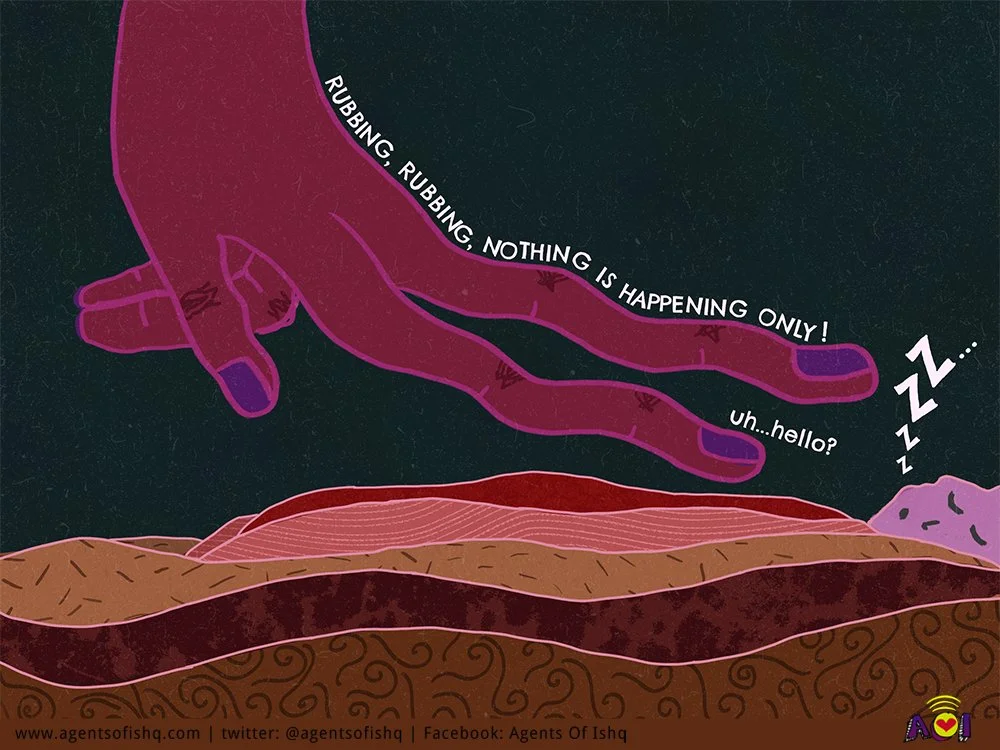
Agents of Ishq (2021)
When thinking about communities, I wonder if our mothers are a part of these circles, and can we talk to them about sex? Personally: rarely, if ever. I would argue that the reason runs deeper than just discomfort — I think it's because we've never really allowed ourselves to see our mothers as sexual beings. She is Amma. It's almost unthinkable to imagine her wanting, desiring, enjoying — and I'd argue that's precisely the point. Holly Zwalf, in her introduction to Mothers, Sex, and Sexuality, names this directly: mothers are "not supposed to be sexual," trapped by a prevailing madonna-whore dichotomy that renders the "good mother" entirely fulfilled by her children, with no separate desires of her own. Accepting that this isn't true — that our mothers are, and always have been, people with desires that exist independently of us — feels like a radical first step in liberating our own relationship with pleasure.
This demonstrates that a willingness to talk about sex and pleasure is deeply important to women, no matter how difficult it is to get there. Anushka Radha Sen’s exploration of her complex relationship with orgasms is a useful point of discussion here. As she charts her frustration at not being able to orgasm and the steps she took to understand her body, her intimate and vulnerable writing reminds readers of the importance of exploring their bodies and the sense of agency that lies there.
In talking about exploring the body, a delicious little scene from Lust Stories (link to scene) comes to mind. In it, the protagonist discovers the immeasurable joys of a vibrator, but much to her displeasure, this happens in front of her whole family! Despite the inescapable embarrassment in this scene, it's still a testament to the joy of using sex toys in exploring one’s pleasure. But vibrators can be an expensive affair, and everyone deserves to feel pleasure. If you’d like to learn more, I found the wonderful Seema Anand’s commentary on the 101 for sex toys rather intriguing. If you haven’t got a sex toy, there are still ways to explore your body. For anyone interested in learning more about masturbation and pleasure, I highly recommend exploring the Agents of Ishq website and (gaysi). They have a well-curated body of work that can serve as your guide to exploring pleasure.
Pleasure with Others
All this talk about orgasms points to an important question- what about the orgasm gap? As this article explains, the orgasm gap refers to the frequency with which men and women orgasm during heterosexual intercourse, with men reaching climax more often than women. A phenomenon most women are all too familiar with!
This idea is built on by Debjann Banerjee in the article The Orgasm Gap: Power, Politics, and the Psychodynamics of Pleasure Inequity, which points out that the orgasm gap can often be tied to seeing penetration as the default mode of sex. Here, all forms of sexual pleasure outside of penile-vaginal penetration are not deemed “real” and are relegated to the realm of foreplay or afterthought. There is a clear heterosexual imperative here that prioritises male-centred sexual scripts.
The best way to destabilise the male-centredness of heterosexual sex is often through open communication. Talking to your partner about what you want and what works for you is equally as important as discussions about what makes you uncomfortable. Take Monica Geller for example. Remember that famous scene from Friends- Seven! Seven! Seven! Luckily for her, the friend she taught about our several erogenous zones ended up being the “best she's ever had”. As uncomfortable and anxiety-inducing as these conversations may be, engaging in them allows us to offer alternative narratives on experiencing pleasure.
Patricia Tio takes an intriguing approach to this conversation. Her work focuses on providing “an honest and untampered representation [of female sexuality]”. To this end, Tio curated a series of photographs that show women immediately after sex. Tio would sit by her phone awaiting a message from her friends and rush to them with her camera in hand to document pleasure without an exploitative male gaze. Her subjects weren't asked to change how they looked or perform for the camera — the images simply reveal, as writer Hannah Abel-Hirsch put it, "the female experience of sex for what it is: individual, everyday, and varied." Many of Tio's subjects were, notably, uneasy about being photographed at all, worried about what family or friends might think, which says something on its own about how rarely women are given room to be unguarded in their own pleasure. That discomfort is echoed in journalist Katherine Rowland's book The Pleasure Gap, cited in the piece, which found many women struggle simply to name what they want in the first place. Tio’s work is a response to this struggle, aiming to reclaim pleasure by allowing women to be seen as they are after sex.
Another important aspect we must talk about is the rise of BDSM and submissive sex culture. Of course, this isn’t inherently bad. Negotiated, consensual kink has a long, well-documented history of being genuinely pleasurable and psychologically healthy. But there's a difference between choosing rough sex and being talked into it, and lately that line has gotten blurry. On TikTok's #FreakTok (#ChokeMe alone sits at 45.3 million views), "vanilla" has become somewhat of an insult. One woman, interviewed by i-D, describes watching peers "push themselves to seem like they enjoy really extreme things just to be part of the in-crowd," until "the type of sex you have has become this huge competition."
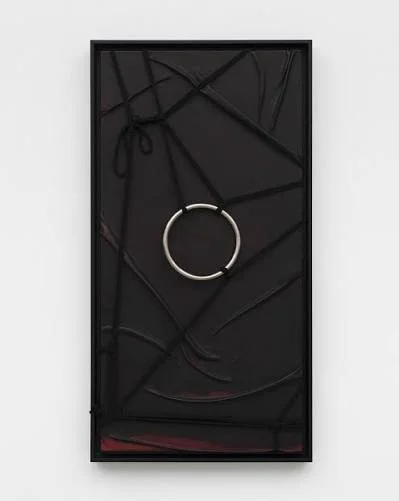
Tiona Nekkia McClodden, Never Let Me Go (2023–ongoing)
An article by Dazed provides an additional layer to this conversation. Smith argues that it's "less about choking, and more about men feeling entitled to women's bodies," often absorbed uncritically from porn that's become many people's only sex education. I would argue that the blame doesn’t lie with the BDSM community. As YourTango points out, "the BDSM and fetish community are not doing these things without both parties willingly consenting." What we're actually watching is the aesthetic of kink, stripped of the consent that made it kink in the first place, repackaged as the new bar for what counts as good sex.
As someone who enjoys rough sex, I found that communicating my boundaries and being aware of the discourse I am situated in has helped me navigate the changing politics of BDSM culture and my experiences of pleasure. However, for all those interested in exploring the BDSM space, I urge you to do your research and understand what you like to avoid the pressure of ‘trying to spice up your sex life’. I suggest engaging with Seema Anand's and Sachee Malhotra’s content. As south asian creators, they are able to navigate sex through the complex socio-political climate we are placed in as South Asian women.
Disability and Pleasure
As a neurodivergent woman, I've often noticed that my experiences with pleasure are significantly different from those of my neurotypical friends. For example, achieving orgasm is much more challenging (not that it's an easy task to begin with). I often find myself distracted by the patterns on the ceiling, the little knick-knacks around the room, or, during particularly ‘boring’ moments, the work emails that await me. I came across an interesting article by Syeda Khaula Saad that discusses this experience. She explores the exhausting effort of trying to stay “present,” which often leads to zoning out. For anyone trying to understand their own experiences, this article is a great place to start. Saad walks the reader through ADHD and the orgasm gap and gives us a few tips on how to navigate pleasure.
Another must-read is "Disability, Sexuality and Consent: How Activists Are Reshaping the Narrative", which profiles seven disabled activists working at the intersection of disability, sexuality, and consent, sharing their lived experiences and advocacy work. Particularly interesting is Niluka Gunawardena’s commentary. She raises the question of how people with disabilities navigate their sexuality in institutionalised settings, and argues that while denying disabled people's sexuality may serve care facilities' interest in limiting potential abuse, it simultaneously denies disabled people the chance to positively express and exercise their sexuality within safe, respectful relationships.
In recent times, we’ve seen a rise in disability representation in cinema. More often than not, media representations are not handled with care. In contrast, Margarita with a Straw has proved to be a timeless classic grappling with nuances of navigating pleasure as a disabled person.
Early in the film, Laila (played by Kalki Koechlin), who has cerebral palsy, is depicted masturbating to pornography in her bedroom. The scene is filmed candidly, without shying away from the subject or adding a moral tone. Critics have noted that this portrayal is one of the first instances in Indian cinema to depict a disabled woman's sexual desire directly; one reviewer remarked that it was a scene he had "never seen on screen" before. This stands in stark contrast to the usual portrayal of disabled sexuality, which is often erased or pathologised; here it's just another Tuesday.
Queering Pleasure
Queering pleasure asks a slightly different question: instead of asking "why is desire denied to us," it asks, "why is desire only recognisable to us in one specific form?" Heartstopper's Isaac Henderson provides a thoughtful response to this. Throughout the show, he is gently and visibly confused, not by his feelings for others, but because everyone around him seems to seek something from their crushes that he simply does not desire. He struggles to articulate why. When he ultimately realises that he is asexual and aromantic, the show presents this not as a lack, but as a different yet completely valid experience. The show also features experiences of trans women, bisexual women, and lesbians. While the primary focus is on Charlie and Nick, it allows for an intersectional representation of queer love, sexuality, and pleasure.
José Esteban Muñoz's work, Cruising Utopia, takes the concept of queerness even further. For Muñoz, queerness is not solely about the present; he famously stated that "queerness is not yet here," suggesting that it functions as a horizon. This perspective, when applied to Isaac's character arc in Heartstopper, reframes the narrative. The story doesn’t present queerness as a completed category that neatly incorporates asexuality; instead, it illustrates queerness as an ongoing, unfinished process of discovering what desire means for an individual, independent of the conventional scripts society expects.
Decolonising pleasure
Looking back on what we discussed earlier about the construction of the ‘good’ woman, I think an important point to end on would be the matter of decolonising pleasure. As pointed out by various scholars, preconceptions around being a ‘good’woman have controlled our pleasures through patriarchal and colonial structures. To reclaim our pleasures then, we must unlearn and deconstruct the social conditioning we have been subjected to.
Disha’s article for (gaysi) provides an interesting perspective to consider. At the centre of her essay lies a simple claim: pleasure has never been allowed to exist for its own sake; it has always had to justify itself through something else. She writes, "Marriage made it respectable. Children made it meaningful. Love made it acceptable." This perspective leaves no room for the idea that people might simply enjoy pleasure. Oral sex serves as her case study because it defies that justification; it cannot be dismissed as a reproductive duty, which is precisely what makes it "insist, stubbornly and unapologetically, that pleasure matters too."
Audre Lorde's essay "Uses of the Erotic: The Erotic as Power" is, in many ways, the argument this reading list has been building toward. She argues that women have been taught to fear the erotic, to see it as trivial at best, shameful at worst, precisely because it is a genuine source of power, and a woman disconnected from her own erotic knowledge is far easier to govern. But for Lorde, the erotic was never just about sex; it's a deep, embodied sense of what truly satisfies you, and once you've felt that fully in one part of your life, you start refusing to settle for less anywhere else, in your work, your relationships, your art, and your politics.
As we come to the end of the reading list, I’m reminded of the countless occasions I’ve shocked an unassuming listener with my ‘frivolous’ discussions of sex. The awkward grimace my ‘uncouth’ stories and questions are met with is an important reminder of why we must discuss pleasure. Analysing, deconstructing, and simply comparing our experiences with pleasure in everyday conversation is, in my opinion, the best way to reclaim our bodies and desires.
Reference List
Abel-Hirsch, H. (2021) 'A photographer experiments with capturing women after sex', 1854 Photography, 13 April. Available at: https://www.1854.photography/2021/04/a-photographer-experiments-with-photographing-women-after-sex/ (Accessed: 10 August 2026).
Abeysekera, S. (1998) 'Women, sexuality, the city and the village', Pravada, 5(4–5), pp. 39–42.
Agents of Ishq (n.d.) 'Disability' [search results]. Available at: https://agentsofishq.com/search?q=disability (Accessed: 10 August 2026).
Anand, S. (n.d.) '101 for sex toys' [video], YouTube. Available at: https://www.youtube.com/watch?v=at40Rq_oP5c (Accessed: 12 August 2026).
ASAP Art (n.d.) 'On postcolonial sartorial trends: Civilizing Serendib by Anoli Perera'. Available at: https://asapconnect.in/post/386/singlestories/on-postcolonial-sartorial-trends (Accessed: 11 August 2026).
Banerjee, D. (2025) 'The orgasm gap: power, politics, and the psychodynamics of pleasure inequity', Journal of Psychosexual Health. doi: 10.1177/26318318251369591.
Chatterjee, P. (1993) The Nation and Its Fragments: Colonial and Postcolonial Histories. Princeton, NJ: Princeton University Press.
CREA and T Brand Studio (2023) 'Disability, sexuality and consent: how activists are reshaping the narrative', The New York Times [paid post]. Available at: https://www.nytimes.com/paidpost/crea/disability-sexuality-and-consent-how-activists-are-reshaping-the-narrative.html (Accessed: 11 August 2026).
de Alwis, M. (1995) '“Gender, politics and the respectable lady”', in P. Jeganathan and Q. Ismail (eds) Unmaking the Nation: The Politics of Identity and History in Modern Sri Lanka. Colombo: Social Scientists' Association, pp. 137–157.
Disha (2026) 'From Gomorrah to going down', Gaysi, 7 July. Available at: https://gaysifamily.com/lifestyle/from-gomorrah-to-going-down/ (Accessed: 11 August 2026).
Findingbeyond (2023) 'Fact or fiction: legends of the mythical creatures that haunt Sri Lanka', 27 January. Available at: https://findingbeyond.com/fact-fiction-legends-mythical-creatures-haunt-sri-lanka/ (Accessed: 11 August 2026).
Gaysi (n.d.) 'Erotica' [website section]. Available at: https://gaysifamily.com/fiction/erotica/ (Accessed: 11 August 2026).
The Guardian (2023) 'The orgasm gap – and how to close it: “don't equate sex and penetration”', 21 March. Available at: https://www.theguardian.com/lifeandstyle/2023/mar/21/the-orgasm-gap-and-how-to-close-it-dont-equate-sex-and-penetration (Accessed: 11 August2026).
Jitesh K. (2025) 'Prepping for pleasure: navigating the ups and downs of bottoming', Gaysi, 7 May. Available at: https://gaysifamily.com/lifestyle/prepping-for-pleasure-navigating-the-ups-and-downs-of-bottoming/ (Accessed: 11 August 2026).
Kandasamy, M. (trans.) (2023) The Book of Desire: Tirukkural, Verses of the Kāmattu-p-pāl. By Tiruvalluvar. London: Galley Beggar Press.
Lorde, A. (1984) 'Uses of the erotic: the erotic as power', in Sister Outsider: Essays and Speeches. Berkeley, CA: Crossing Press.
luna (2024) 'The internet loves sex. Why does it hate sex workers?', The Swaddle, 12 September. Available at: https://www.theswaddle.com/the-internet-loves-sex-why-does-it-hate-sex-workers
Muñoz, J.E. (2009) Cruising Utopia: The Then and There of Queer Futurity. New York: New York University Press.
Obeyesekere, G. (1981) Medusa's Hair: An Essay on Personal Symbols and Religious Experience. Chicago: University of Chicago Press.
Orgasming Hermione (2021) '“Rubbing, rubbing, nothing is happening!”', Agents of Ishq, 5 May. Available at: https://agentsofishq.com/post/rubbing-rubbing-nothing-is-happening (Accessed: 11 August 2026).
Rangan, B. (2015) 'Margarita with a Straw: a light, lovely tale of sexual awakening and other things that make up life', 25 April. Available at: https://baradwajrangan.wordpress.com/2015/04/25/margarita-with-a-straw-a-light-lovely-tale-of-sexual-awakening-and-other-things-that-make-up-life/ (Accessed: 12 August 2026).
Robinson, L. (2021) 'On TikTok, vanilla-shaming is the new kink-shaming', i-D, 2 March. Available at: https://i-d.co/article/tiktok-vanilla-shaming-rough-sex-kinkshaming/ (Accessed: 11 August 2026).
Saad, S.K. (n.d.) 'Is my ADHD messing with my orgasm?', Glamour. Available at: https://www.glamour.com/story/is-my-adhd-messing-with-my-orgasm (Accessed: 11 August 2026).
Sen, A.R. (2017) 'How I taught myself to have orgasms', Agents of Ishq, 19 June. Available at: https://agentsofishq.com/post/how-my-orgasm (Accessed: 11 August 2026).
Smith, S. (2025) 'Why did choking during sex become vanilla?', Dazed, 15 September. Available at: https://www.dazeddigital.com/life-culture/article/68627/1/why-has-choking-during-sex-become-vanilla-kink-bdsm-sexual-norm (Accessed: 11 August 2026) .
Tipton, N. (2021) 'Why TikTok's “vanilla shaming” trend perpetuates dangerous non-consensual relationships', YourTango, 5 February. Available at: https://www.yourtango.com/2021340199/why-tiktok-vanilla-shaming-trend-perpetuates-dangerous-non-consensual-relationships (Accessed: 11 August 2026).
Wickramasinghe, N. (2003) Dressing the Colonised Body: Politics, Clothing and Identity in Colonial Sri Lanka. New Delhi: Orient Longman.
Zwalf, H. (2020) 'Introduction', in H. Zwalf, M. Walks and J. Mortenson (eds) Mothers, Sex, and Sexuality. Bradford, ON: Demeter Press.
Additional Resources
Abeysekera, S. (1998) 'Women, sexuality, the city and the village', Pravada, 5(4–5), pp. 39–42. Available at: https://polity.lk/wp-content/uploads/2024/09/Pravada-5.45-Women-sexuality-the-city-and-the-village.pdf
Kandasamy, M. (trans.) (2023) 'Extract: The Book of Desire', Galley Beggar Press. Available at: https://www.galleybeggar.co.uk/extract-the-book-of-desire
Muralidharan, K. (2024) 'Meena Kandasamy's feminist intervention on the Tirukkural', Himal Southasian, 29 May. Available at: https://www.himalmag.com/meena-kandasamy-book-of-desire-feminist-intervention-on-tirukkural-tiruvalluvar/
Women and Media Collective (2004) Options, 3rd issue. Colombo: Women and Media Collective. Available at: https://www.scribd.com/document/384554008/Options-2004-3rd-Issue
Women and Media Collective (2016) Options, no. 50. Colombo: Women and Media Collective. Available at: https://www.scribd.com/document/327976089/OPTIONS-50-2016
Thadini Liyanage is the present outreach and partnership programme manager at Everystory. She graduated from the University of Kelaniya with an Honours degree in English and is currently reading for a Masters in Gender studies at the University of Colombo. She is a writer and aspiring filmmaker and her work reflects her passion for feminist research and advocacy.
